
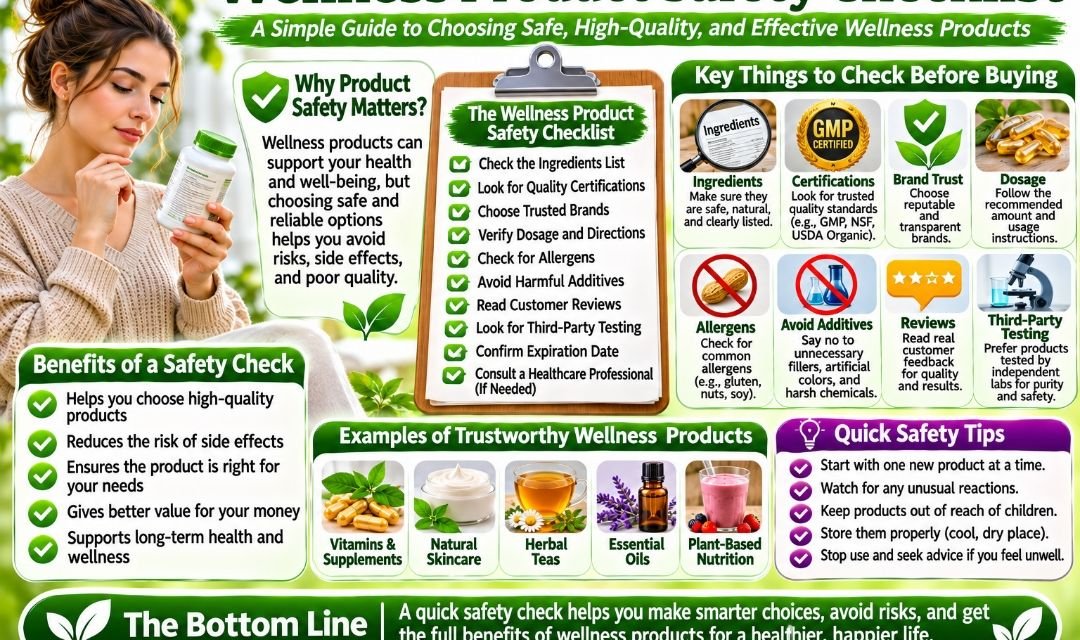
Quick Overview of Wellness Product Safety
| Category | Details |
|---|---|
| Main topic | Wellness Product Safety Checklist |
| Primary goal | Identifying safer, more reliable wellness products |
| Product categories | Supplements, skincare, herbal products, CBD, essential oils |
| First safety step | Review the complete ingredient list |
| Important label details | Ingredients, dosage, warnings, expiration date |
| Quality indicators | Manufacturing standards and relevant testing |
| Main risks | Allergies, contamination, interactions, incorrect labeling |
| CBD considerations | THC content, liver risks, medication interactions |
| Herbal supplements | Check ingredient-specific safety evidence |
| Medical claims | Look for credible scientific support |
| Regulatory status | Depends on country and product category |
| Best approach | Evidence-based, individualized decisions |
Wellness products are not all regulated in the same way.
A moisturizer, vitamin supplement, herbal tea, and prescription medicine may follow different legal requirements.
This makes it important to understand what a product actually contains and what it is intended to do.
Some wellness products have well-established uses.
Others are marketed with claims that have little reliable scientific support.
The following guide provides a practical checklist for evaluating products before purchase and use.
What Is a Wellness Product?
A wellness product is an item marketed to support health, personal care, comfort, or general well-being.
Common categories include dietary supplements, skincare products, herbal preparations, fitness accessories, and relaxation products.
Some products contain biologically active substances.
Others primarily serve cosmetic or practical purposes.
For example, a moisturizer may help reduce skin dryness.
A protein powder may help someone meet nutritional requirements.
A concentrated herbal supplement may have more complex safety considerations.
Therefore, product safety should be evaluated according to the specific product rather than the wellness label alone.
The Complete Wellness Product Safety Checklist
Use the following checklist before purchasing a new wellness product.
15-point product safety checklist
0 of 15 reviewed
Ingredients
The complete ingredient list is available and understandable.
Intended use
The product’s purpose is clear and appropriate for my needs.
Dosage
Serving size, concentration, and instructions are provided where relevant.
Warnings
Allergy information, precautions, and contraindications have been reviewed.
Interactions
Potential interactions with medications and other supplements have been considered.
Evidence
The advertised benefits are supported by credible evidence.
Manufacturer
The manufacturer or responsible business is identifiable.
Quality testing
Relevant independent testing or quality verification is available where appropriate.
Contamination
Reasonable safeguards against contamination are documented.
Expiration
The product is within its expiration or recommended use period.
Storage
Storage instructions are clear and practical.
Regulatory status
The product’s legal and regulatory status has been checked.
Special risks
Pregnancy, medical conditions, age, and other individual risks have been considered.
Marketing claims
The product does not rely on guaranteed cures or unrealistic promises.
Professional advice
Qualified medical or pharmaceutical advice has been obtained when needed.
Completing the checklist does not certify a product as safe. Some risks cannot be identified from labels or consumer research alone.
1. Check the Complete Ingredient List
The ingredient list is one of the most important parts of product safety.
It helps consumers identify substances they may wish to avoid.
For example, someone with a known allergy should carefully review relevant ingredients.
However, not every ingredient is listed in the same way across product categories.
Some products use botanical names.
Others list chemical names or standardized ingredient terminology.
Consumers should avoid assuming that unfamiliar names are necessarily harmful.
2. Understand the Product’s Intended Purpose
A wellness product should have a clearly defined purpose.
For example, a moisturizer may be intended to reduce skin dryness.
A fiber supplement may be intended to support bowel regularity.
However, products promising to treat many unrelated conditions should be viewed cautiously.
Broad claims may indicate exaggerated marketing.
A product’s intended use should be supported by appropriate evidence.
3. Review Dosage and Concentration
The amount of an ingredient matters.
Some substances are safe at ordinary dietary levels but can cause adverse effects when taken in concentrated forms.
For example, culinary herbs are different from high-dose herbal extracts.
Vitamin supplements can also cause harm when taken in excessive amounts.
Consumers should follow appropriate directions and avoid combining multiple products without considering total exposure.
4. Look for Allergy Warnings
Allergic reactions can occur with both natural and synthetic ingredients.
Common allergens may include nuts, soy, certain fragrances, and botanical extracts.
However, the relevant risks depend on the individual.
A product that is safe for one person may cause a reaction in another.
People with known allergies should review labels carefully.
Severe allergic symptoms require urgent medical attention.
5. Check Medication Interactions
Some wellness products can affect how medications work.
This is particularly important for herbal supplements and cannabinoid-containing products.
For example, certain botanical compounds can alter drug metabolism.
CBD can also interact with several medications.
People taking prescription medicines should consult a qualified healthcare professional or pharmacist before starting potentially interacting supplements.
6. Evaluate Scientific Evidence
Marketing claims should be supported by reliable evidence.
However, not all evidence is equally strong.
A laboratory experiment does not establish that a product works in humans.
Animal studies may provide useful preliminary information but cannot prove clinical effectiveness.
Human clinical trials are generally more relevant for evaluating health claims.
Even then, study quality, sample size, and results matter.
7. Identify the Manufacturer
A reliable product should provide clear information about the responsible manufacturer or distributor.
This may include the business name, contact details, and product identification information.
However, a professional-looking website does not guarantee product quality.
Consumers should remain cautious about businesses that provide little information about their operations.
8. Understand Quality Testing
Quality testing may help identify contamination or incorrect ingredient concentrations.
Depending on the product, testing may examine microbes, heavy metals, pesticides, or active compounds.
However, not every test is relevant to every product.
A skincare product and a CBD oil may require different testing considerations.
Testing should be appropriate for the product category.
9. Check for Contamination Risks
Wellness products may become contaminated during cultivation, manufacturing, storage, or transportation.
Potential contaminants include bacteria, fungi, heavy metals, and pesticides.
However, contamination risk varies.
Responsible manufacturing practices can help reduce these risks.
Consumers should be cautious about products with unexplained quality concerns or official safety warnings.
10. Review Expiration Dates
Expiration dates and recommended use periods provide information about product stability or quality.
However, the meaning of these dates depends on the product category.
Some products may lose potency over time.
Others may become unsuitable because of microbial contamination or changes in formulation.
Products should be stored and used according to appropriate instructions.
11. Follow Storage Instructions
Storage conditions can influence product quality.
Heat, moisture, light, and air exposure may affect certain ingredients.
For example, some oils can deteriorate when stored improperly.
Other products may require refrigeration.
Consumers should follow the manufacturer’s instructions and avoid using products that show signs of spoilage.
12. Understand Regulatory Status
Wellness products may be regulated as foods, dietary supplements, cosmetics, medicines, or other categories.
The requirements differ by jurisdiction.
A product legally sold in one country may be restricted elsewhere.
Consumers should not assume that online availability means regulatory approval.
Official product classifications and applicable rules should be checked when relevant.
13. Consider Individual Health Conditions
Product safety depends partly on the person using it.
Pregnancy, breastfeeding, age, allergies, liver disease, kidney disease, and other medical conditions may affect risk.
Some supplements may be unsuitable for certain individuals.
Children may also be more vulnerable to concentrated ingredients.
Professional guidance is particularly important when individual health risks are present.
14. Recognize Misleading Marketing Claims
Wellness advertising sometimes uses language that sounds scientific without providing meaningful evidence.
Examples include claims about removing all toxins, curing chronic diseases, or producing guaranteed results.
Such promises should raise concerns.
Products should not be selected solely because of dramatic testimonials or celebrity endorsements.
15. Seek Professional Advice When Necessary
Healthcare professionals can help assess product risks.
Pharmacists may provide information about medication interactions.
Doctors can evaluate whether a supplement is appropriate for a medical condition.
Registered dietitians can provide individualized nutrition guidance.
Professional advice is especially important when using concentrated supplements or products with pharmacological effects.
Wellness Product Safety by Category
Different product types require different safety considerations.
| Product type | Main safety concerns |
|---|---|
| Vitamins | Excessive doses, interactions |
| Herbal supplements | Side effects, contamination, interactions |
| Skincare | Irritation, allergies, product stability |
| Essential oils | Skin irritation, toxicity if swallowed |
| Protein powders | Ingredient quality, allergens, contamination |
| CBD products | THC content, interactions, liver-related risks |
| Herbal teas | Ingredient-specific precautions |
| Sleep supplements | Sedation, interactions, uncertain effectiveness |
| Fitness supplements | Stimulants, undeclared ingredients |
| Botanical cosmetics | Fragrance sensitivity, formulation safety |
A single safety standard cannot be applied identically to every category.
Herbal Supplement Safety Checklist
Herbal supplements deserve particular attention because some contain concentrated biologically active compounds.
Before using a herbal supplement, consumers should consider the specific plant species, extract type, dose, and potential interactions.
For example, turmeric used in cooking differs from concentrated curcumin capsules.
Some high-dose botanical extracts have been associated with liver injury.
Natural origin does not eliminate risk.
CBD Product Safety Checklist
CBD products are often marketed for relaxation, sleep, and general wellness.
However, CBD has pharmacological effects and may cause adverse reactions.
Important safety considerations include:
-
Confirming the actual CBD concentration
-
Checking whether THC is present
-
Reviewing relevant laboratory testing
-
Considering possible medication interactions
-
Understanding potential liver-related risks
-
Checking local legal requirements
-
Avoiding unsupported medical claims
CBD should not be treated as a harmless ingredient simply because it comes from a plant.
Essential Oil Safety Checklist
Essential oils are concentrated aromatic substances.
They may be used in fragrances, personal care products, and aromatherapy.
However, they can cause irritation or allergic reactions.
Some essential oils are toxic when swallowed.
They should not be applied to the skin in inappropriate concentrations.
Special caution is needed around children and pets.
Skincare Product Safety Checklist
Skincare products should be evaluated according to skin type, ingredients, and intended use.
People with sensitive skin may react to fragrances or botanical extracts.
Patch testing may help identify some reactions.
However, patch testing cannot guarantee that a product will be safe.
Persistent irritation should be evaluated appropriately.
Protein Powder and Nutrition Product Safety
Protein powders may be useful for people who need convenient protein sources.
However, they are not necessary for everyone.
Consumers should check protein content, allergens, added ingredients, and relevant quality testing.
Some products may contain excessive added sugar or other unwanted substances.
The overall nutritional pattern matters more than relying on a single supplement.
How to Recognize Fake Wellness Products
Counterfeit or misleading products can create serious safety concerns.
Warning signs may include unusual packaging, inconsistent labeling, missing manufacturer information, and suspiciously low prices.
However, price alone does not establish authenticity.
Consumers should use reliable purchasing channels and verify product information when possible.
What Is Third-Party Testing?
Third-party testing involves evaluation by an organization separate from the product manufacturer.
It may help verify ingredient identity, concentration, or selected contaminants.
However, the value of testing depends on the laboratory, methods, and scope.
A third-party testing claim should not be treated as proof that a product is medically effective.
Understanding Certificates of Analysis
A certificate of analysis, or COA, reports laboratory findings for selected product characteristics.
For example, a CBD product COA may report cannabinoid concentrations.
Other tests may examine contaminants.
However, a COA should be relevant to the actual product batch.
Consumers should be cautious about incomplete, outdated, or unverifiable testing documents.
Common Wellness Product Safety Myths
Myth 1: Natural Means Safe
Natural substances can cause toxicity, allergies, and medication interactions.
Myth 2: More Vitamins Are Always Better
Excessive vitamin intake can cause harm.
Myth 3: Herbal Supplements Cannot Affect Prescription Medicines
Some herbal ingredients can significantly alter medication effects.
Myth 4: Third-Party Testing Proves Effectiveness
Testing may verify selected quality characteristics but does not establish clinical benefits.
Myth 5: CBD Products Are Always THC-Free
Some CBD products contain THC.
Myth 6: Expensive Products Are Automatically Better
Price does not guarantee safety or effectiveness.
Myth 7: Organic Products Cannot Cause Allergies
Organic ingredients can still trigger allergic reactions.
Myth 8: Customer Reviews Prove Medical Benefits
Testimonials cannot replace controlled scientific research.
Wellness Product Safety and Online Shopping
Online shopping provides access to many wellness products.
However, consumers may encounter misleading listings or products that do not meet local requirements.
Product descriptions should be reviewed carefully.
Consumers should also verify manufacturer information and relevant safety warnings.
A polished online store does not automatically indicate reliable manufacturing.
How to Compare Two Wellness Products
When comparing products, focus on meaningful characteristics.
| Comparison factor | Product A | Product B |
|---|---|---|
| Ingredient transparency | Check | Check |
| Appropriate concentration | Check | Check |
| Safety warnings | Check | Check |
| Relevant quality testing | Check | Check |
| Evidence for claims | Check | Check |
| Manufacturer details | Check | Check |
| Regulatory status | Check | Check |
| Value for intended use | Check | Check |
The better choice is not necessarily the product with the longest ingredient list.
A simpler product may be more appropriate when it meets the intended need.
When Should You Stop Using a Wellness Product?
Stop using a product and seek appropriate medical advice if you experience concerning adverse effects.
These may include persistent vomiting, severe skin irritation, unusual dizziness, or other significant symptoms.
Emergency symptoms such as difficulty breathing, swelling of the throat, or loss of consciousness require immediate medical assistance.
People should also stop using products subject to relevant official safety recalls.
Frequently Asked Questions About Wellness Product Safety
1. What is a wellness product safety checklist?
It is a set of steps used to evaluate ingredients, labeling, quality, and potential risks.
2. Why is product safety important?
It helps reduce avoidable exposure to harmful ingredients, contamination, and misleading claims.
3. Are natural wellness products always safe?
No. Natural ingredients can cause side effects and interactions.
4. How can I check supplement quality?
Review labeling, manufacturing information, and relevant independent testing.
5. What is third-party testing?
It is product testing performed by an organization separate from the manufacturer.
6. What is a certificate of analysis?
A laboratory report describing selected product characteristics.
7. Are herbal supplements regulated?
Regulation varies by country and product classification.
8. Can herbal supplements interact with medications?
Yes. Some interactions can be significant.
9. Are CBD products safe?
CBD can cause adverse effects and medication interactions. Safety depends on the product and individual.
10. Do CBD products always contain THC?
Not always, but some may contain THC.
11. Are essential oils safe to swallow?
Some essential oils are toxic when ingested and should not be swallowed casually.
12. Can skincare products cause allergies?
Yes. Both natural and synthetic ingredients can trigger reactions.
13. Is organic the same as safe?
No. Organic production standards do not guarantee safety for every person.
14. Are expensive supplements better?
Not necessarily. Price does not establish quality or effectiveness.
15. What should I check on a product label?
Ingredients, directions, warnings, manufacturer details, and relevant dates.
16. Can vitamins be harmful?
Yes. Excessive doses of certain vitamins can cause adverse effects.
17. Are wellness products medically approved?
Some products have specific approvals, but many supplements and cosmetics are not approved as treatments for diseases.
18. How can I identify misleading claims?
Be cautious about guaranteed cures and dramatic promises lacking credible evidence.
19. Can protein powders contain contaminants?
Yes. Quality control and appropriate testing are important.
20. What should I do after an allergic reaction?
Stop using the product and seek appropriate medical care. Severe reactions require emergency assistance.
21. Are online wellness products reliable?
Some are, but online availability does not guarantee safety or authenticity.
22. Can supplements replace a balanced diet?
No. Supplements should not be treated as replacements for overall good nutrition.
23. Is a long ingredient list dangerous?
Not necessarily. Safety depends on the actual ingredients and formulation.
24. Should pregnant people use herbal supplements?
They should seek qualified medical guidance because some products may be unsuitable.
25. What is the most important wellness product safety rule?
Evaluate the actual ingredients, intended use, scientific evidence, and individual risks rather than trusting marketing claims.
Final Thoughts
A wellness product safety checklist helps consumers make more informed decisions about supplements, skincare, herbal preparations, CBD products, and other wellness items.
The most important steps include reviewing ingredient lists, understanding dosage, checking warnings, evaluating scientific evidence, and considering possible medication interactions.
Manufacturing quality and relevant testing can also provide useful information.
However, no checklist can guarantee that every product is completely safe.
Natural, organic, and plant-based labels do not automatically establish safety or effectiveness.
Consumers should remain cautious about unrealistic medical claims and products with unclear ingredients.
Professional guidance is particularly important for people with medical conditions, those taking medications, and anyone considering concentrated supplements.
The safest approach is to choose products that meet genuine needs, have appropriate evidence supporting their use, and present manageable risks.
For more wellness product guides, natural ingredient education, herbal supplement safety tips, hemp and CBD information, and beginner-friendly health articles, visit Picanto Magazine.
Medical Disclaimer: This article is for general educational purposes only and does not replace professional medical advice, diagnosis, or treatment. Consult a qualified healthcare professional before using supplements, CBD products, concentrated herbal extracts, or other biologically active wellness preparations, particularly if you take medications or have an existing medical condition.