
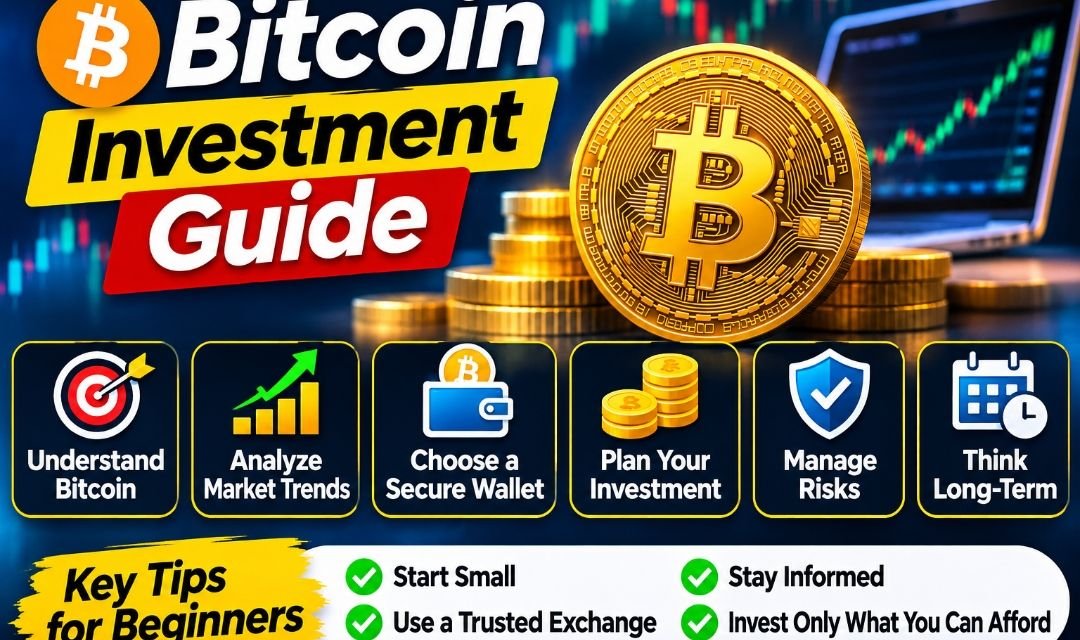
Bitcoin investment guide is a useful starting point for beginners who want to understand Bitcoin, digital assets, cryptocurrency investing, and the risks of the crypto market. Bitcoin is a decentralized digital asset that operates through blockchain technology, allowing people to transfer value without relying on a traditional bank to maintain its transaction ledger. Since its launch in 2009, Bitcoin has become one of the most recognized cryptocurrencies in the world. However, Bitcoin prices can rise or fall dramatically, making research, financial planning, and security essential before considering an investment.
Quick Overview of Bitcoin Investment
| Category | Details |
|---|---|
| Main topic | Bitcoin Investment Guide |
| Cryptocurrency | Bitcoin (BTC) |
| Introduced | 2009 |
| Creator | Satoshi Nakamoto (pseudonym) |
| Technology | Blockchain |
| Maximum supply | 21 million BTC |
| Common investment methods | Direct purchase, eligible investment products |
| Investment approaches | Long-term holding, periodic buying, trading |
| Storage options | Hardware wallets, software wallets, custodial accounts |
| Main risks | Price volatility, scams, hacking, regulatory changes |
| Security essentials | Strong authentication, secure private keys |
| Beginner priority | Education, risk management, and secure storage |
| Profit guarantee | None |
Bitcoin attracts attention because of its limited supply, decentralized design, and growing role in discussions about digital finance.
Some people view Bitcoin as a long-term speculative investment.
Others use it for transferring digital value or exploring blockchain technology.
However, Bitcoin is not the same as money held in a traditional savings account.
Its market price can change significantly within hours or days.
Investors may experience large gains, but they can also suffer substantial losses.
Understanding these risks is essential before purchasing Bitcoin.
This guide explains how Bitcoin investing works, how to evaluate purchasing methods, how to protect digital assets, and how to avoid common investment mistakes.
What Is Bitcoin?
Bitcoin is a digital asset that operates on a decentralized computer network.
It was introduced in 2009.
The Bitcoin network maintains a public transaction ledger called a blockchain.
Participants use cryptographic methods to verify ownership and authorize transfers.
Unlike traditional currencies, Bitcoin is not issued by a central bank.
Its protocol establishes rules governing the creation and transfer of bitcoins.
However, Bitcoin’s market value depends on supply and demand.
There is no guarantee that its price will increase.
Why Do People Invest in Bitcoin?
People consider Bitcoin for several reasons.
Some are interested in its limited supply.
Others want exposure to cryptocurrency technology.
Some investors view Bitcoin as a speculative alternative asset.
However, these reasons do not guarantee financial success.
Bitcoin does not produce business earnings or pay dividends simply because someone holds it.
Its market price can be influenced by investor demand, regulation, liquidity, and broader financial conditions.
Before investing, understand why you are considering Bitcoin and whether the risks fit your financial circumstances.
1. Understand How Bitcoin Works Before Investing
Bitcoin operates through blockchain technology.
A blockchain is a shared digital ledger.
It records transactions according to network rules.
Bitcoin uses proof of work to help secure its transaction history.
Miners use computing equipment to compete in producing valid blocks.
However, investors do not need to mine Bitcoin to own it.
Bitcoin can be purchased through supported platforms or received from another user.
Understanding basic transactions, wallets, and private keys can help reduce costly mistakes.
2. Learn About Bitcoin’s Limited Supply
Bitcoin has a maximum supply of 21 million coins under its existing protocol rules.
New bitcoins enter circulation through mining rewards.
The mining reward decreases at scheduled intervals through a process commonly called halving.
However, limited supply does not automatically create increasing prices.
Demand can fall.
Market conditions can change.
A scarce asset can still lose significant value.
Supply should therefore be considered alongside other investment risks.
3. Understand Bitcoin Price Volatility
Volatility describes how much an asset’s price changes.
Bitcoin is known for substantial price fluctuations.
Its value may rise sharply during periods of strong demand.
It may also decline rapidly.
For example, an investor who purchases Bitcoin shortly before a major price decline may experience significant losses.
However, future price movements cannot be predicted reliably.
Avoid assuming that previous increases will continue.
4. Decide Whether Bitcoin Fits Your Financial Situation
Bitcoin is a high-risk asset.
Before considering a purchase, review your financial priorities.
Essential living expenses should come first.
Emergency savings and debt obligations also matter.
Money needed for rent, healthcare, education, or other near-term necessities should not be exposed to substantial speculative risk.
However, every person’s financial situation is different.
A qualified financial adviser can help evaluate whether any cryptocurrency exposure is appropriate.
5. Research Bitcoin Investment Platforms
Some investors purchase Bitcoin through cryptocurrency exchanges.
Others may access Bitcoin exposure through regulated investment products where available.
However, platform availability and legal requirements vary by country.
Before using any service, examine its regulatory status, security arrangements, fees, withdrawal rules, and customer protections.
Do not assume that a platform is safe because it advertises low fees or has many users.
6. Understand Cryptocurrency Exchange Fees
Buying Bitcoin may involve several costs.
These can include trading fees, payment processing charges, spreads, and withdrawal fees.
A spread is the difference between buying and selling prices.
However, exchanges use different pricing structures.
A platform advertising zero trading fees may still include costs in its quoted prices.
Compare the total amount paid rather than one advertised fee.
Common Bitcoin Investment Costs
| Cost | Explanation |
|---|---|
| Trading fee | Charge for executing a purchase or sale |
| Spread | Difference between buying and selling prices |
| Deposit fee | Possible charge for adding funds |
| Withdrawal fee | Charge for moving assets or money |
| Network fee | Cost associated with blockchain transactions |
| Custody fee | Possible charge for asset storage or management |
| Investment product fee | Ongoing charges for certain regulated products |
7. Learn How to Buy Bitcoin
The exact purchasing process depends on your location and platform.
However, a typical process includes several stages.
Step 1: Check Local Regulations
Confirm whether the service and transaction are permitted in your jurisdiction.
Step 2: Choose a Suitable Provider
Review its reputation, security, fees, and withdrawal policies.
Step 3: Complete Required Verification
Some platforms require identity verification.
Only submit personal information through verified official channels.
Step 4: Review the Purchase Details
Check the Bitcoin amount, total price, and fees.
Step 5: Confirm the Transaction
Only proceed after understanding the risks and costs.
Step 6: Plan Secure Storage
Decide whether to use a custodial account or self-custody wallet.
However, purchasing Bitcoin is not necessary to learn about it.
Beginners can study the market without risking money.
8. Understand Bitcoin Wallets
A Bitcoin wallet manages the cryptographic keys used to control Bitcoin.
The bitcoins themselves are recorded on the blockchain.
Wallets help users authorize transactions.
There are several types.
Software Wallets
Software wallets operate through mobile or desktop applications.
They can be convenient.
However, internet-connected devices may face security threats.
Hardware Wallets
Hardware wallets are physical devices designed to protect private keys.
They may reduce some online risks.
However, users must still verify transactions and protect recovery information.
Custodial Wallets
Custodial services control private keys on behalf of customers.
These services can be convenient.
However, users depend on the provider’s security and financial stability.
Self-Custody Wallets
Self-custody wallets allow users to control their own keys.
However, losing recovery information may permanently prevent access to funds.
9. Protect Your Bitcoin Investment
Security is essential when dealing with Bitcoin.
Use strong passwords.
Enable suitable multifactor authentication.
Keep devices updated.
Verify wallet software.
Avoid suspicious links.
Never share private keys or recovery phrases.
However, even strong security measures cannot eliminate every risk.
Exchange failures, scams, and user mistakes can still cause losses.
Bitcoin Investment Security Checklist
Bitcoin Security Checklist
0 of 10
These precautions may reduce common security risks but cannot guarantee that Bitcoin funds will remain safe.
10. Bitcoin Long-Term Investing Explained
Long-term investing involves holding an asset for an extended period.
Some Bitcoin investors use this approach because they believe in the network’s future adoption.
However, long-term holding does not guarantee profits.
Bitcoin may experience prolonged price declines.
Its future value remains uncertain.
Investors should avoid assuming that time alone will eliminate cryptocurrency risk.
11. What Is Dollar-Cost Averaging in Bitcoin?
Dollar-cost averaging, commonly called DCA, involves investing a fixed amount at regular intervals.
For example, someone might allocate a predetermined amount each month.
When prices are lower, the same amount purchases more Bitcoin.
When prices are higher, it purchases less.
However, DCA does not guarantee profits or prevent losses.
It also does not make an unsuitable investment appropriate.
The method simply spreads purchase timing across multiple transactions.
Example of Dollar-Cost Averaging
| Month | Hypothetical Bitcoin price | Amount invested | Bitcoin purchased |
|---|---|---|---|
| January | $60,000 | $100 | 0.001667 BTC |
| February | $50,000 | $100 | 0.002000 BTC |
| March | $40,000 | $100 | 0.002500 BTC |
| April | $50,000 | $100 | 0.002000 BTC |
| Total | — | $400 | 0.008167 BTC |
These prices are hypothetical, exclude fees, and are not historical or current Bitcoin quotations.
The example shows how regular purchases result in different quantities of Bitcoin.
However, the final investment value still depends on the market price.
12. Bitcoin Trading vs. Long-Term Investing
Bitcoin trading and investing involve different approaches.
Trading usually focuses on shorter-term price movements.
Long-term investing generally involves holding Bitcoin for extended periods.
However, both strategies involve financial risk.
| Feature | Long-term investing | Short-term trading |
|---|---|---|
| Time horizon | Months or years | Minutes, days, or weeks |
| Transaction frequency | Usually lower | Usually higher |
| Time commitment | Periodic research | Frequent monitoring |
| Fees | Potentially fewer transactions | Can accumulate quickly |
| Main risk | Extended price declines | Volatility, timing, leverage |
| Guaranteed returns | No | No |
Short-term trading can be especially difficult for beginners.
Frequent decisions and transaction costs may increase the chance of losses.
13. Avoid Bitcoin Leverage Trading as a Beginner
Leverage allows traders to control a larger position using borrowed funds or margin.
However, leverage magnifies losses as well as gains.
A relatively small market movement can trigger liquidation.
This may cause rapid loss of the funds supporting the position.
Beginners should understand that leverage introduces risks beyond ordinary Bitcoin ownership.
Avoid borrowing money to speculate on cryptocurrency prices.
14. Understand Bitcoin Market Cycles
Bitcoin has experienced periods of rising and falling prices.
These are sometimes described as market cycles.
A rising market is commonly called a bull market.
A declining market is called a bear market.
However, market cycles do not follow a guaranteed schedule.
Past performance cannot reliably predict future prices.
Investors should avoid treating historical patterns as certain forecasts.
15. How Bitcoin Halving Works
Bitcoin halving reduces the subsidy miners receive for adding valid blocks.
The event occurs approximately every four years, based on Bitcoin’s block schedule.
The subsidy was reduced from 6.25 BTC to 3.125 BTC in April 2024.
Future halvings will continue according to the protocol unless its rules change.
However, halving does not guarantee a price increase.
Market demand and many other factors influence Bitcoin’s value.
16. Bitcoin Investment Risks
Bitcoin investing involves several major risks.
Market Risk
Bitcoin prices can decline substantially.
Security Risk
Private keys, devices, and exchange accounts may be compromised.
Custody Risk
A custodial provider may fail or restrict withdrawals.
Regulatory Risk
Government rules may change.
Liquidity Risk
Market conditions may affect the price at which Bitcoin can be sold.
Operational Risk
Software problems, incorrect addresses, and other mistakes can cause losses.
Fraud Risk
Scammers may use fake exchanges, impersonation, or fraudulent investment offers.
Understanding these risks is essential before considering an investment.
17. Bitcoin vs. Gold vs. Stocks
Bitcoin is often compared with gold and stocks.
However, these assets have different characteristics.
| Feature | Bitcoin | Gold | Stocks |
|---|---|---|---|
| Asset type | Digital asset | Physical commodity | Ownership in companies |
| Income generation | None from holding BTC itself | None from holding physical gold itself | Some companies pay dividends |
| Price volatility | Often very high | Varies | Varies by company and market |
| Storage | Digital custody | Physical or financial custody | Brokerage or custody account |
| Main risks | Volatility, custody, regulation | Price movements, storage | Business and market risks |
| Guaranteed returns | No | No | No |
No asset is automatically suitable for every investor.
Investment decisions should consider financial goals, risk tolerance, and time horizon.
18. Bitcoin ETFs and Investment Products
Some markets offer exchange-traded products that provide exposure to Bitcoin.
These may allow eligible investors to access Bitcoin through traditional brokerage accounts.
However, product structures vary.
Some hold Bitcoin directly.
Others use different arrangements.
Fees, custody, regulations, and risks differ by product.
Bitcoin investment products can still lose substantial value.
They should not be confused with insured savings accounts.
19. How to Avoid Bitcoin Investment Scams
Bitcoin scams can be highly convincing.
Fraudsters may promise guaranteed daily profits.
Some create fake trading platforms.
Others impersonate financial advisers or cryptocurrency companies.
Common warning signs include:
-
Guaranteed or unusually high returns
-
Pressure to invest immediately
-
Requests for private keys or recovery phrases
-
Unexpected messages offering investment opportunities
-
Demands for additional payments to unlock withdrawals
-
Fake celebrity endorsements
-
Unverified trading applications
However, a professional-looking website does not prove legitimacy.
Always verify financial services independently.
20. Bitcoin Taxes and Regulations
Bitcoin tax treatment depends on the country.
Some jurisdictions tax gains when Bitcoin is sold or exchanged.
Others have different reporting rules.
However, regulations may change.
Keep accurate records of purchase dates, transaction amounts, fees, and sales.
Consult a qualified tax professional when appropriate.
Before using any exchange or investment service, check current local laws.
21. Common Bitcoin Investment Mistakes
Beginners sometimes make decisions based on excitement rather than research.
One mistake is buying Bitcoin because its price recently increased.
Another is investing money needed for essential expenses.
Some investors overlook exchange fees.
Others leave large balances with providers without understanding custody risks.
Another serious mistake is sharing private keys.
Some people also believe that Bitcoin’s limited supply guarantees future profits.
However, scarcity does not eliminate investment risk.
Avoid emotional decisions and unrealistic expectations.
22. How to Research Bitcoin Before Investing
Research should begin with understanding Bitcoin’s technology.
Learn about blockchain, mining, transactions, and supply rules.
Study how wallets work.
Review custody options.
Understand exchange fees.
Consider historical volatility without treating it as a forecast.
Check local regulations.
However, avoid relying entirely on social media influencers or promotional content.
Independent research is essential.
23. How to Build a Bitcoin Investment Plan
A responsible investment plan begins with financial priorities.
Consider your income, savings, debt, and essential expenses.
Decide whether cryptocurrency exposure is appropriate at all.
Understand how much loss you could tolerate.
Review the costs and custody arrangements.
Consider how an investment would fit into a diversified financial plan.
However, there is no universal Bitcoin allocation suitable for everyone.
A qualified financial adviser can help with personalized decisions.
24. How to Monitor a Bitcoin Investment
Bitcoin investors may monitor prices, transaction records, and security notifications.
However, checking prices constantly can encourage emotional decisions.
Consider reviewing your investment according to a planned schedule.
Maintain accurate records.
Review account security.
Stay informed about important regulatory or custody changes.
Avoid reacting automatically to every market movement.
25. The Future of Bitcoin Investing
Bitcoin’s future depends on several uncertain factors.
These include technology, regulation, investor demand, market liquidity, and broader economic conditions.
Some people expect increased adoption.
Others remain concerned about volatility, environmental impacts, and financial risks.
However, no one can reliably guarantee Bitcoin’s future price.
Technological development does not automatically translate into investment returns.
Beginners should distinguish between facts about the Bitcoin network and speculation about its market value.
Bitcoin Investment Calculator
Use this example calculator to explore how a hypothetical Bitcoin investment could change in value. It does not predict future returns.
Bitcoin Investment Scenario Calculator
Starting amount
$500
Hypothetical price change
-30%
Example purchase fee
1%
Hypothetical final value
$346.50
Net gain or loss
−$153.50
Illustration only. Includes a sample purchase fee but excludes selling fees, taxes, spreads, and other expenses. Price changes are hypothetical and are not forecasts.
Final Thoughts
A Bitcoin investment guide should help beginners understand both the opportunities and the serious risks associated with digital assets.
Bitcoin is an innovative technology that allows digital value to move through a decentralized network.
Its limited supply and blockchain design make it different from traditional financial assets.
However, Bitcoin remains highly speculative.
Prices can change dramatically.
Exchanges and wallets may face security problems.
Regulations can change.
Investment losses may be substantial.
Before considering Bitcoin, learn about blockchain technology, wallet security, fees, and market volatility.
Avoid borrowing money to speculate.
Never invest funds required for essential living expenses.
Do not trust guaranteed-profit claims.
Most importantly, remember that understanding an investment is more valuable than rushing to purchase it.
Careful research, responsible financial planning, and strong security habits can help beginners make more informed decisions about Bitcoin.
Frequently Asked Questions About Bitcoin Investment
1. What is Bitcoin investing?
Bitcoin investing involves purchasing or obtaining exposure to Bitcoin with the possibility of future gains or losses.
2. Is Bitcoin a good investment for beginners?
Bitcoin is highly volatile and may not be suitable for many beginners. Suitability depends on personal finances and risk tolerance.
3. Can I invest a small amount in Bitcoin?
Some platforms support small purchases, although minimum amounts and fees vary.
4. Do I need to buy one whole Bitcoin?
No. Bitcoin can be divided into smaller units.
5. What is the smallest Bitcoin unit?
The smallest standard Bitcoin unit is called a satoshi.
6. Is Bitcoin investment safe?
Bitcoin involves market, custody, security, and regulatory risks. No investment return is guaranteed.
7. Can Bitcoin lose all its value?
A severe decline, potentially including a total loss of investment value, is possible.
8. What is a Bitcoin wallet?
A Bitcoin wallet manages the cryptographic keys used to control Bitcoin.
9. What is the safest way to store Bitcoin?
No storage method is completely risk-free. Security depends on custody arrangements, user practices, and specific threats.
10. What is dollar-cost averaging?
It is a strategy of investing a fixed amount at regular intervals.
11. Does dollar-cost averaging guarantee profits?
No. It does not prevent investment losses.
12. What is Bitcoin halving?
Bitcoin halving reduces the block subsidy paid to miners according to the network’s schedule.
13. Does Bitcoin halving increase prices?
Not necessarily. Future price movements remain uncertain.
14. Can I buy Bitcoin through an exchange?
In some jurisdictions, eligible users can purchase Bitcoin through cryptocurrency exchanges.
15. What are Bitcoin transaction fees?
They are costs associated with blockchain transfers or platform services.
16. What is a Bitcoin ETF?
It is an exchange-traded investment product that may provide exposure to Bitcoin, depending on its structure.
17. Is Bitcoin better than gold?
Neither asset is universally better. They have different risks and characteristics.
18. Can Bitcoin generate passive income?
Holding Bitcoin itself does not automatically produce interest or dividends. Products offering yield introduce additional risks.
19. What is Bitcoin trading?
Bitcoin trading involves buying and selling Bitcoin, often to speculate on price movements.
20. Is Bitcoin trading risky?
Yes. Trading can produce substantial losses, especially when leverage is involved.
21. How can I avoid Bitcoin scams?
Verify platforms, reject guaranteed-return promises, and never share private keys or recovery phrases.
22. Do I have to pay taxes on Bitcoin?
Tax obligations depend on local laws and the nature of your transactions.
23. Should I borrow money to buy Bitcoin?
Borrowing to speculate on Bitcoin can magnify financial risk and is particularly dangerous for beginners.
24. Can Bitcoin prices be predicted?
No method can reliably guarantee future Bitcoin prices.
25. What is the most important Bitcoin investment tip?
Understand the risks, protect your financial stability, and learn how Bitcoin and custody systems work before considering any purchase.
For more cryptocurrency education, blockchain technology guides, investment learning resources, and digital finance articles, visit Picanto Magazine