
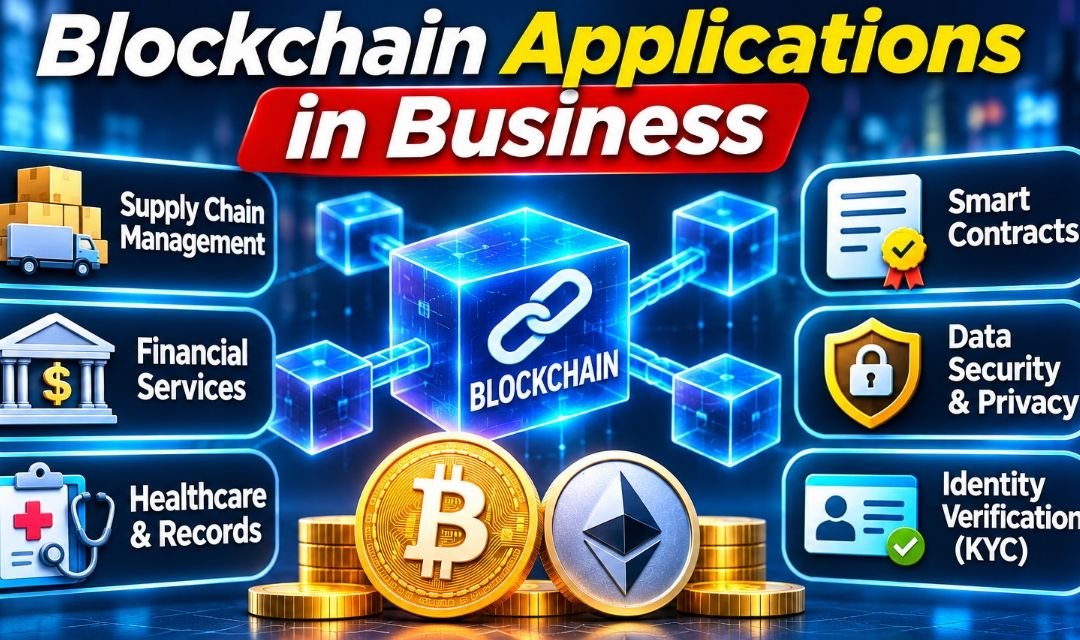
Blockchain applications in business are changing how companies explore ways to record transactions, share information, and manage digital processes. Blockchain technology allows organizations to maintain shared records using cryptography and agreed network rules. Instead of depending entirely on one central database, some businesses use distributed ledger systems to improve record verification and coordination between different organizations. According to the basic principles of blockchain technology, information can be organized into connected blocks that make unauthorized changes difficult to hide. Businesses are exploring this technology in banking, supply chains, healthcare, insurance, real estate, and many other industries.
Quick Overview of Blockchain Applications in Business
| Category | Details |
|---|---|
| Main topic | Blockchain Applications in Business |
| Technology | Blockchain and distributed ledger technology |
| Main purpose | Shared records and transaction verification |
| Popular industries | Banking, logistics, healthcare, insurance |
| Common applications | Supply chain tracking, payments, smart contracts |
| Blockchain types | Public, private, consortium |
| Important features | Transparency, traceability, cryptographic verification |
| Business benefits | Shared information, automation, auditability |
| Major challenges | Cost, scalability, integration, regulation |
| Smart contract use | Automated business processes |
| Security considerations | Private keys, access control, software vulnerabilities |
| Future opportunities | Tokenization, digital identity, shared infrastructure |
Businesses increasingly depend on digital systems to manage information.
Companies process payments, track products, maintain records, and exchange information with partners.
However, these activities often involve separate databases.
When several organizations maintain different versions of the same information, disagreements and delays may occur.
Blockchain technology offers one possible way to coordinate shared records.
For example, manufacturers and distributors may use a blockchain-based system to record shipping events.
Financial organizations may explore blockchain for settlement and asset transfers.
Insurance companies may investigate smart contracts for certain automated processes.
However, blockchain is not automatically the best solution.
Its usefulness depends on the business problem, implementation costs, security requirements, and whether multiple parties genuinely need a shared ledger.
This guide explores 20 blockchain applications in business, their potential benefits, limitations, and future opportunities.
What Is Blockchain Technology in Business?
Blockchain technology in business refers to using blockchain-based systems to support commercial activities.
These systems may record transactions, verify information, or coordinate processes between organizations.
A blockchain is a type of distributed ledger.
It uses cryptographic methods and network rules to maintain a shared record.
However, business blockchains differ from public cryptocurrency networks.
Some are permissioned.
This means only approved organizations can participate.
Others use public blockchain networks for selected activities.
The appropriate design depends on privacy, governance, and operational requirements.
How Does Blockchain Work for Businesses?
A business blockchain may involve several organizations sharing a common ledger.
For example, a manufacturer, shipping company, and retailer may need to track the movement of products.
Instead of maintaining completely separate records, they may participate in a shared system.
A typical process works as follows:
-
A participant creates a transaction or record.
-
The information is submitted to the network.
-
The network checks whether the record follows agreed rules.
-
Authorized participants validate the information.
-
The accepted record becomes part of the shared ledger.
-
Other participants can access the information according to their permissions.
However, blockchain cannot automatically determine whether the original information is truthful.
Businesses still need reliable data collection, verification, and governance.
1. Blockchain in Supply Chain Management
Supply chain management is one of the most discussed business applications of blockchain.
A supply chain involves manufacturers, suppliers, shipping companies, warehouses, and retailers.
These organizations often use different information systems.
Blockchain may help them maintain shared records about products and shipments.
For example, a company may record when a shipment leaves a warehouse.
The shipping provider may record its arrival at another location.
The retailer may then confirm receipt.
However, the accuracy of the system depends on the information entered.
Potential benefits: Better coordination, traceability, and record verification.
Main challenges: Data accuracy, system integration, and participation costs.
2. Blockchain in Banking and Financial Services
Banks and financial institutions are exploring blockchain technology for selected financial processes.
Potential uses include settlement, tokenized assets, and shared transaction records.
Traditional financial systems often involve multiple intermediaries.
Blockchain-based systems may reduce certain reconciliation requirements.
However, financial institutions must comply with regulations and security standards.
Blockchain is not automatically faster or cheaper than established payment infrastructure.
Potential benefits: Shared settlement records and reduced reconciliation.
Main challenges: Regulation, interoperability, and operational risk.
3. Blockchain for International Payments
International payments may involve banks, payment networks, and currency conversion services.
Blockchain networks can transfer digital value across borders.
Some systems use stablecoins or tokenized financial instruments.
However, international transfers may still require regulated financial intermediaries.
Currency conversion, liquidity, compliance, and transaction fees can affect total costs.
Therefore, blockchain does not guarantee inexpensive international payments.
4. Blockchain in Healthcare Businesses
Healthcare organizations manage sensitive patient information and administrative records.
Blockchain may support record integrity verification and controlled information-sharing processes.
For example, a healthcare network could use cryptographic records to verify whether a document has changed.
However, storing private medical information directly on a public blockchain can create serious privacy problems.
Healthcare applications require strong access controls and compliance with applicable laws.
Potential benefits: Record verification and coordination.
Main challenges: Privacy, interoperability, and regulatory compliance.
5. Blockchain in Insurance
Insurance companies process policies, claims, and payments.
Some insurers are exploring smart contracts to automate selected processes.
For example, a predefined payment process could be triggered when reliable external information confirms a qualifying event.
However, insurance claims often involve complicated circumstances.
Human review and legal interpretation may still be necessary.
Smart contracts cannot independently determine whether every claim is valid.
6. Blockchain in Real Estate
Real estate transactions involve ownership records, contracts, payments, and legal documentation.
Blockchain may help organizations coordinate selected records.
For example, a blockchain-based system could maintain a shared history of certain property-related events.
However, recording information on a blockchain does not automatically create legal ownership.
Property rights depend on laws and recognized registration systems.
Blockchain applications must work with those legal requirements.
7. Blockchain in Retail Businesses
Retailers manage inventory, suppliers, payments, and customer transactions.
Blockchain may support product traceability and selected digital payment processes.
For example, a retailer could use shared records to track product origins.
However, blockchain does not automatically improve every retail operation.
Traditional databases may be simpler and less expensive.
Businesses should compare alternatives before investing in blockchain infrastructure.
8. Blockchain in E-Commerce
E-commerce businesses handle online orders, payments, and product records.
Blockchain may support digital asset payments or shared transaction verification.
Some platforms also explore token-based loyalty programs.
However, cryptocurrency payments can introduce price volatility and compliance requirements.
Customers may also face transaction fees or irreversible payment errors.
Blockchain should be evaluated alongside conventional e-commerce systems.
9. Blockchain for Smart Contracts
Smart contracts are computer programs that execute according to predefined rules.
They can support automated business processes on compatible blockchain networks.
For example, a smart contract might release a digital payment when specified conditions are met.
However, the conditions must be represented accurately in software.
A coding error can cause unexpected outcomes.
Smart contracts also cannot automatically verify every real-world event.
External data sources may be required.
10. Blockchain in Logistics and Transportation
Logistics companies coordinate shipping, delivery, customs, and warehouse operations.
A shared blockchain ledger may help participants track important events.
For example, several companies could record the status of a shipment.
However, blockchain does not physically track goods by itself.
Reliable tracking still requires sensors, scanning systems, and accurate reporting.
The main potential benefit is improved coordination between organizations.
11. Blockchain in Manufacturing
Manufacturers manage raw materials, components, production records, and suppliers.
Blockchain may help record selected manufacturing events.
For example, a company could maintain shared information about component origins.
This may support quality investigations or product recalls.
However, businesses must ensure that records accurately reflect physical production.
Blockchain cannot automatically detect defective components.
12. Blockchain in Food Safety
Food businesses may use blockchain systems to support product traceability.
For example, participants could record information about agricultural products moving through distribution networks.
This may help organizations investigate the source of a product.
However, blockchain cannot independently confirm that food is safe.
Physical inspections, laboratory testing, and reliable data remain essential.
13. Blockchain in Pharmaceutical Supply Chains
Pharmaceutical companies manage complex supply chains.
These involve manufacturers, distributors, healthcare providers, and regulators.
Blockchain may support shared records about product movement.
However, preventing counterfeit medicine requires more than digital records.
Physical packaging controls, inspections, and verification systems remain important.
Blockchain can support these processes but cannot replace them.
14. Blockchain for Digital Identity
Businesses frequently verify customer and employee identities.
Blockchain-based identity systems may allow individuals or organizations to manage certain digital credentials.
For example, a credential issuer could create a verifiable record.
Another organization could check its authenticity.
However, blockchain cannot automatically prove that an identity claim is truthful.
Trustworthy identity verification and privacy protection remain necessary.
15. Blockchain in Human Resources
Human resources departments manage employee credentials, employment records, and verification processes.
Blockchain-based systems may help verify certain certificates or employment-related credentials.
For example, an employer could verify that a credential was issued by an authorized organization.
However, sensitive employee information requires careful privacy management.
Blockchain should not be used to expose personal records unnecessarily.
16. Blockchain in Education Businesses
Educational institutions and training providers issue certificates and qualifications.
Blockchain may help verify the authenticity of digital credentials.
For example, a training provider could issue a credential that employers can independently verify.
However, cryptographic verification only confirms information about the credential.
It does not automatically guarantee the quality of the education received.
17. Blockchain in Energy Businesses
Energy companies manage production, distribution, and consumption records.
Blockchain-based systems have been explored for energy trading and shared settlement.
For example, participants in a local energy market may use digital records to coordinate transactions.
However, energy systems require reliable physical infrastructure and regulatory oversight.
Blockchain cannot replace electricity grids or operational controls.
18. Blockchain in Media and Entertainment
Media businesses manage digital content, licensing, and royalty payments.
Blockchain may support certain ownership records or automated payment arrangements.
For example, a digital platform could use smart contracts to distribute payments under defined rules.
However, blockchain records do not automatically establish copyright ownership.
Legal agreements and intellectual property laws remain important.
19. Blockchain for Customer Loyalty Programs
Businesses use loyalty programs to reward customers.
Blockchain-based tokens may represent points or digital benefits.
These systems could allow selected partners to coordinate rewards.
However, token-based programs introduce technical and regulatory considerations.
Traditional loyalty databases may be simpler for many businesses.
The value of blockchain depends on whether shared token infrastructure provides a genuine advantage.
20. Blockchain for Business Auditing
Auditing involves examining records and verifying transactions.
Blockchain may provide a shared, tamper-evident history of certain events.
This can help auditors trace changes and review transaction records.
However, blockchain does not guarantee that recorded information is accurate.
Auditors must still evaluate the reliability of underlying data and business controls.
Blockchain Applications in Business: Industry Comparison
| Industry | Potential blockchain application | Main challenge |
|---|---|---|
| Banking | Settlement and shared financial records | Regulation |
| Supply chain | Product traceability | Data accuracy |
| Healthcare | Record integrity verification | Patient privacy |
| Insurance | Automated claims processes | External data reliability |
| Real estate | Shared property transaction records | Legal recognition |
| Retail | Product tracking | Integration costs |
| E-commerce | Digital asset payments | Volatility and compliance |
| Logistics | Shipment event records | Participant coordination |
| Manufacturing | Component traceability | Physical data verification |
| Food industry | Product origin records | Reliable inspections |
| Pharmaceuticals | Distribution tracking | Counterfeit prevention |
| Human resources | Credential verification | Privacy |
| Education | Digital certificates | Credential trust |
| Energy | Shared settlement | Infrastructure and regulation |
| Entertainment | Royalty administration | Copyright enforcement |
| Auditing | Transaction history verification | Source data quality |
Benefits of Blockchain Applications in Business
Blockchain may offer several advantages when used appropriately.
Improved Transparency
A shared ledger can allow authorized participants to view consistent records.
However, transparency depends on network permissions.
Better Traceability
Blockchain can help organizations follow recorded transactions or events.
However, the original information must be accurate.
Reduced Reconciliation
When organizations share a common record, they may spend less time comparing separate databases.
However, implementation costs may offset potential savings.
Process Automation
Smart contracts can automate certain predefined activities.
However, complex business decisions may still require human judgment.
Tamper-Evident Records
Cryptographic methods can make unauthorized changes easier to detect.
However, blockchain cannot prevent every form of fraud.
Coordination Between Organizations
Blockchain may help businesses exchange information without giving one participant complete control over the shared database.
However, governance agreements remain necessary.
Challenges of Blockchain Adoption in Business
Despite its potential benefits, blockchain adoption involves important challenges.
1. Implementation Costs
Businesses may need new software, technical expertise, and infrastructure.
2. Integration Problems
Existing systems may not connect easily with blockchain platforms.
3. Scalability
Some blockchain networks have limited transaction capacity.
4. Data Privacy
Shared records may expose sensitive business information.
5. Regulation
Legal requirements differ between industries and countries.
6. Governance
Organizations must agree on who controls access, updates, and dispute resolution.
7. Security
Smart contracts, private keys, and connected applications can be compromised.
8. Data Accuracy
Blockchain cannot guarantee that information entered into a system is truthful.
These challenges explain why blockchain is not appropriate for every business process.
Public vs Private Blockchain for Business
Businesses can choose between different network structures.
| Feature | Public blockchain | Private blockchain |
|---|---|---|
| Participation | Generally open | Restricted |
| Governance | Distributed according to network rules | Controlled by approved organizations |
| Transparency | Often publicly auditable | Permission-based |
| Privacy | Requires careful design | More control over access |
| Transaction costs | May involve network fees | Depends on infrastructure |
| Common use | Public digital assets and applications | Internal or shared enterprise systems |
A consortium blockchain is another option.
It allows multiple approved organizations to share governance.
The best architecture depends on business requirements.
Blockchain vs Traditional Business Databases
Blockchain is not always necessary.
Traditional databases are often faster, easier to maintain, and less expensive.
However, blockchain may be useful when several independent organizations need a shared record without relying entirely on one central administrator.
| Feature | Blockchain | Traditional database |
|---|---|---|
| Main structure | Shared ledger | Centrally managed or distributed database |
| Governance | May involve multiple organizations | Usually managed by an administrator |
| Record modification | Often tamper-evident | Usually easier to update |
| Performance | May involve consensus overhead | Often optimized for speed |
| Implementation complexity | Can be high | Often lower |
| Best use | Shared records across organizations | Conventional business operations |
The decision should be based on actual business needs rather than technology trends.
How Businesses Can Implement Blockchain Technology
Businesses considering blockchain should begin with a clear problem.
A practical implementation process may include several stages.
Step 1: Identify the Business Problem
Determine whether the company faces recordkeeping, verification, or coordination challenges.
Step 2: Evaluate Existing Solutions
Compare blockchain with traditional databases and other technologies.
Step 3: Identify Participants
Determine which organizations need access to shared information.
Step 4: Select the Network Model
Consider public, private, or consortium blockchain structures.
Step 5: Establish Governance
Define permissions, responsibilities, and dispute resolution procedures.
Step 6: Review Security and Privacy
Evaluate key management, access controls, and data protection requirements.
Step 7: Develop a Pilot Project
Test the proposed system on a limited scale.
Step 8: Measure Business Results
Compare costs, performance, reliability, and operational benefits.
Step 9: Address Legal Requirements
Review applicable regulations and contractual obligations.
Step 10: Decide Whether to Expand
Scale the system only if testing demonstrates meaningful value.
Blockchain Implementation Cost for Businesses
Blockchain implementation costs vary significantly.
A small pilot project may require fewer resources than a large enterprise network.
Expenses can include software development, infrastructure, security testing, legal review, and employee training.
However, no single cost estimate applies to every project.
Businesses should calculate both initial expenses and ongoing maintenance.
| Cost category | What it includes |
|---|---|
| Planning | Requirements and feasibility analysis |
| Development | Software and smart contract creation |
| Infrastructure | Hosting, nodes, and network services |
| Security | Testing, monitoring, key management |
| Integration | Connecting existing business systems |
| Compliance | Legal and regulatory review |
| Training | Employee education |
| Maintenance | Updates, support, and operations |
A blockchain project should demonstrate business value that justifies these costs.
Blockchain Security in Business
Blockchain systems can provide strong record verification.
However, they are not automatically secure.
Businesses must protect private keys and administrative accounts.
Smart contracts require careful testing.
Connected applications may contain vulnerabilities.
Organizations must also plan for operational failures and unauthorized access.
Permissioned networks require clear governance.
A secure blockchain implementation combines technical controls with reliable business procedures.
Blockchain and Smart Contracts in Business Automation
Smart contracts can automate certain business rules.
For example, a contract might release a payment when specified digital conditions are satisfied.
However, smart contracts cannot independently verify every real-world event.
External data sources may be needed.
These sources are sometimes called oracles.
If the external information is incorrect, the automated result may also be incorrect.
Therefore, smart contract automation requires careful design and testing.
Blockchain Applications for Small Businesses
Small businesses may explore blockchain for selected activities.
Examples include digital payments, product traceability, and shared records with business partners.
However, small businesses should avoid adopting blockchain simply because it is popular.
Traditional accounting software, payment processors, and databases may provide better value.
The key question is whether blockchain solves a specific problem more effectively than existing alternatives.
Future of Blockchain Applications in Business
Blockchain technology continues to develop.
Several areas may influence future business adoption.
Tokenized Financial Assets
Organizations are exploring digital representations of certain financial instruments.
However, legal rights and custody arrangements remain essential.
Improved Interoperability
Developers are working on systems that allow different blockchain networks to exchange information.
However, interoperability can introduce security risks.
Privacy Technologies
New cryptographic methods may help businesses verify information while limiting data exposure.
Enterprise Automation
Smart contracts may support additional business workflows.
However, automation requires reliable inputs and appropriate oversight.
Digital Credentials
Blockchain-related verification methods may support selected identity and certification processes.
Shared Industry Infrastructure
Organizations may cooperate on shared recordkeeping systems.
However, successful adoption requires governance, standards, and economic incentives.
The future of blockchain in business will depend on practical results rather than promises alone.
Final Thoughts
Blockchain applications in business offer opportunities for improving shared records, transaction verification, and coordination between organizations.
Banking institutions are exploring blockchain-based settlement.
Supply chain companies may use distributed ledgers for product traceability.
Healthcare organizations are investigating record verification.
Insurance businesses may use smart contracts for selected automated processes.
Manufacturers, retailers, and logistics providers are also exploring possible applications.
However, blockchain is not a universal solution.
Its benefits depend on the quality of implementation, governance, data accuracy, and economic value.
Businesses must also consider privacy, security, regulation, and long-term maintenance.
For many organizations, traditional databases remain the better option.
The most successful blockchain applications will be those that solve genuine business problems rather than simply introducing new technology.
Frequently Asked Questions About Blockchain Applications in Business
1. What are blockchain applications in business?
They are uses of blockchain technology to support commercial processes such as recordkeeping, payments, verification, and coordination.
2. How does blockchain help businesses?
Blockchain may improve shared records, traceability, and selected automated processes.
3. Which industries use blockchain technology?
Industries exploring blockchain include banking, logistics, healthcare, insurance, manufacturing, and retail.
4. Is blockchain useful for small businesses?
It can be useful for certain needs, but traditional systems may be simpler and less expensive.
5. What is blockchain in supply chain management?
It involves using shared ledger records to track selected supply chain events.
6. How is blockchain used in banking?
Financial institutions explore blockchain for settlement, tokenization, and shared records.
7. Can blockchain improve international payments?
It may support digital value transfers, but fees, regulations, and liquidity remain important.
8. What is a smart contract in business?
It is a program that executes predefined rules on a supported blockchain.
9. Can smart contracts replace traditional contracts?
Not automatically. Legal agreements and enforceability depend on applicable law.
10. Is blockchain secure for businesses?
Blockchain can provide useful security properties, but systems still face technical and operational risks.
11. What is a private blockchain?
A private blockchain restricts participation to approved users or organizations.
12. What is a consortium blockchain?
It is a blockchain governed by a group of participating organizations.
13. Can blockchain prevent fraud?
It may make certain record changes easier to detect, but it cannot eliminate fraud.
14. Can blockchain verify product authenticity?
It can support traceability, but physical verification and reliable data remain necessary.
15. Is blockchain better than a database?
Not always. Traditional databases may be more suitable for many business applications.
16. Can blockchain reduce business costs?
It may reduce certain reconciliation or coordination costs, but implementation can be expensive.
17. What is blockchain tokenization?
Tokenization involves representing assets or claims through digital tokens.
18. Can blockchain improve healthcare?
It may support selected verification and information-sharing processes, subject to privacy requirements.
19. How does blockchain support insurance?
Smart contracts may automate certain predefined insurance processes.
20. Can blockchain help real estate businesses?
It may support shared transaction records, but legal ownership depends on recognized legal systems.
21. What are the main risks of business blockchain adoption?
Major risks include cost, security vulnerabilities, privacy problems, governance disputes, and integration challenges.
22. Does every business need blockchain?
No. Many business problems can be solved effectively with traditional technology.
23. Can blockchain improve auditing?
It may provide tamper-evident records, but auditors must still verify source information.
24. What is the future of blockchain in business?
Potential developments include tokenization, digital credentials, privacy technologies, and shared enterprise systems.
25. What should a business do before adopting blockchain?
It should identify a specific problem, compare alternatives, evaluate costs, and test the proposed solution.
For more blockchain technology guides, cryptocurrency education, business innovation articles, and digital finance insights, visit Picanto Magazine