
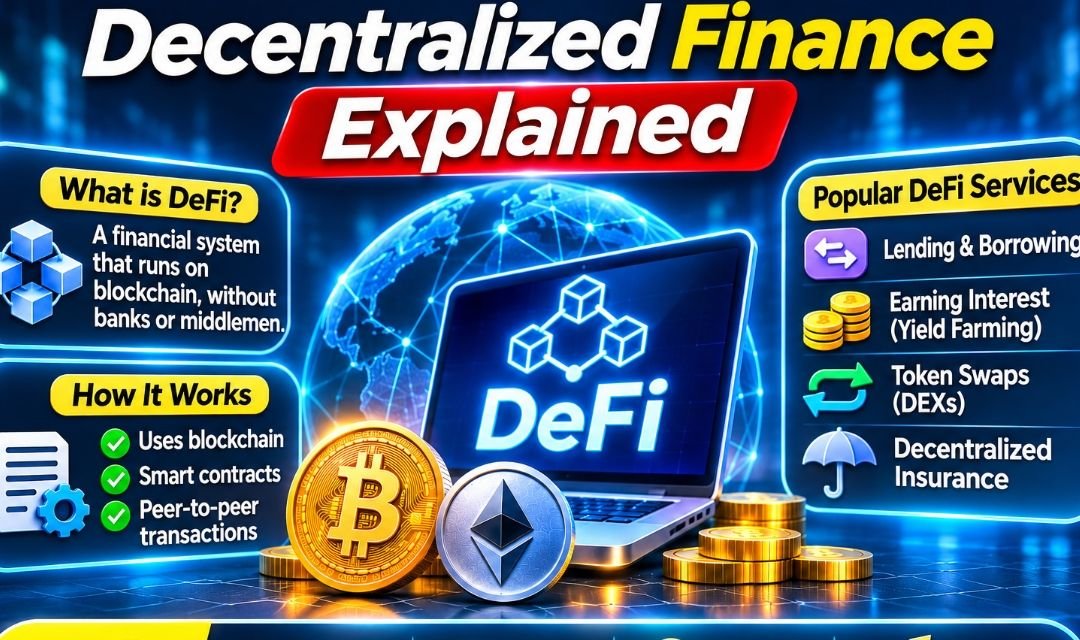
Decentralized finance explained in simple words means understanding a financial system that uses blockchain technology and computer programs to provide services without always depending on traditional banks or financial institutions. Decentralized finance, commonly called DeFi, allows users to access activities such as cryptocurrency trading, lending, borrowing, and digital asset management through blockchain-based applications. Unlike conventional financial services, many DeFi platforms operate through smart contracts that automatically execute predefined rules. According to the concept of decentralized finance, these systems aim to make certain financial activities more open and accessible, although they also introduce significant technical, financial, and security risks.
Quick Overview of Decentralized Finance
| Category | Details |
|---|---|
| Full name | Decentralized Finance |
| Short name | DeFi |
| Main technology | Blockchain |
| Popular blockchain ecosystem | Ethereum |
| Main purpose | Blockchain-based financial services |
| Common applications | Lending, borrowing, trading, staking |
| Key technology | Smart contracts |
| Popular DeFi protocols | Uniswap, Aave, Compound, Maker-related protocols |
| Common digital assets | ETH, stablecoins, other crypto tokens |
| Traditional bank required | Not always |
| Main benefits | Open access, transparency, programmability |
| Main risks | Hacking, scams, volatility, liquidation |
| User requirements | Compatible wallet, supported assets, network fees |
| Guaranteed returns | No |
Decentralized finance has become an important part of the cryptocurrency industry.
Many people first learn about cryptocurrencies through Bitcoin.
However, blockchain technology supports more than digital payments.
Developers can create financial applications that operate through smart contracts.
These applications may allow people to exchange tokens, provide liquidity, or borrow cryptocurrency.
Some services operate without traditional financial intermediaries.
However, that does not mean every DeFi platform is completely decentralized.
Developers, governance groups, infrastructure providers, and other organizations may still influence how a protocol operates.
Understanding these differences is important before using decentralized financial applications.
What Is Decentralized Finance?
Decentralized finance is a collection of financial services built using blockchain networks and smart contracts.
Traditional financial systems often depend on banks, brokers, payment processors, and other intermediaries.
DeFi protocols attempt to perform selected financial activities through software.
For example, a decentralized exchange may allow users to trade supported cryptocurrency tokens through a liquidity pool.
A lending protocol may allow users to supply digital assets or borrow against collateral.
However, these systems are not free from risk.
Smart contracts can contain errors.
Digital assets can lose value.
Users may also lose funds through scams, incorrect transactions, or stolen private keys.
Therefore, DeFi should be understood as an alternative technical approach to certain financial services rather than a guaranteed improvement over traditional banking.
How Does Decentralized Finance Work?
DeFi applications generally operate through blockchain networks.
Smart contracts provide the rules for many transactions.
A simplified DeFi process may involve the following steps.
Step 1: A User Creates a Crypto Wallet
A compatible cryptocurrency wallet allows the user to manage blockchain assets.
Examples include wallets that support Ethereum and other smart contract networks.
However, wallet security is essential.
Step 2: The User Accesses a DeFi Application
The user visits a supported decentralized application.
This application may offer trading, lending, or other services.
However, fake websites can imitate legitimate platforms.
Step 3: The Wallet Connects
The user may connect their wallet to the application.
Connecting a wallet does not necessarily transfer funds.
However, later transaction approvals can grant powerful permissions.
Step 4: A Smart Contract Processes the Transaction
The user submits a transaction.
The smart contract executes according to its programmed rules.
Step 5: The Blockchain Records the Result
The transaction is processed according to the blockchain network’s rules.
Fees and confirmation times vary.
Step 6: The User Manages the Position
The user may need to monitor collateral, token values, or smart contract permissions.
Some DeFi activities require ongoing attention because market conditions can change rapidly.
What Are Smart Contracts in DeFi?
Smart contracts are computer programs that run on supported blockchain networks.
They execute rules defined in their code.
For example, a lending smart contract may calculate borrowing limits based on deposited collateral.
A decentralized exchange contract may determine how tokens are exchanged.
However, smart contracts are not automatically secure.
A coding mistake may allow unexpected behavior.
Some contracts also include administrator permissions.
Therefore, users should understand that automated execution does not guarantee fairness or safety.
Main Components of Decentralized Finance
DeFi depends on several technologies.
| Component | Main purpose |
|---|---|
| Blockchain | Records transactions |
| Smart contracts | Execute programmed rules |
| Crypto wallets | Manage keys and transactions |
| Decentralized applications | Provide user interfaces |
| Liquidity pools | Supply assets for certain trading activities |
| Oracles | Provide external information |
| Governance tokens | May support protocol decisions |
| Stablecoins | Represent assets designed to maintain a reference value |
| Validators | Help secure supported blockchain networks |
Each component introduces its own security and operational considerations.
1. Decentralized Exchanges (DEXs)
Decentralized exchanges allow users to trade supported digital assets through blockchain-based systems.
Unlike conventional centralized exchanges, many DEXs use smart contracts for transaction execution.
A popular example is Uniswap.
Some decentralized exchanges use automated market makers.
These systems rely on liquidity pools rather than traditional order books.
However, decentralized trading can involve price slippage, network fees, and malicious tokens.
Users must also verify the exact token contract and blockchain network.
2. DeFi Lending
DeFi lending protocols allow users to supply supported digital assets to a lending market.
Other users may borrow assets under specified conditions.
Protocols such as Aave and Compound are well-known examples of decentralized lending systems.
Interest rates may change according to supply and demand.
However, supplying cryptocurrency does not guarantee earnings.
Smart contract vulnerabilities, asset price movements, and protocol failures can cause losses.
3. DeFi Borrowing
DeFi borrowing allows users to borrow supported assets through smart contracts.
Many protocols require collateral.
For example, a user may deposit one digital asset to borrow another.
However, collateral values can change rapidly.
If collateral falls below a required level, liquidation may occur.
This can result in substantial losses.
DeFi borrowing is not equivalent to receiving a risk-free bank loan.
4. Yield Farming
Yield farming involves supplying cryptocurrency to DeFi protocols in exchange for potential rewards.
Users may provide liquidity or participate in other financial arrangements.
Rewards can come from transaction fees, token incentives, or lending activity.
However, advertised yields may change quickly.
Some protocols offer extremely high returns that are unsustainable or associated with serious risks.
Yield farming can involve smart contract failures, token price declines, and liquidity problems.
5. Liquidity Pools
A liquidity pool contains digital assets made available for certain decentralized trading or financial activities.
Users who supply assets are commonly called liquidity providers.
Some protocols distribute trading fees or incentives to liquidity providers.
However, providing liquidity can expose users to impermanent loss.
This occurs when the value of assets in a liquidity pool changes relative to holding those assets separately.
In some circumstances, losses can be substantial.
6. Stablecoins in DeFi
Stablecoins are digital assets designed to maintain a reference value.
Many aim to track the value of a currency such as the US dollar.
Stablecoins are commonly used in decentralized lending, trading, and payments.
However, a stablecoin is not automatically equivalent to cash in a bank account.
Its stability depends on its design, reserves, redemption arrangements, and market conditions.
Some stablecoins have lost their intended value.
Therefore, stablecoin risk should never be ignored.
7. Staking and DeFi
Staking involves committing eligible cryptocurrency to participate in securing a Proof of Stake blockchain.
Some DeFi applications offer services related to staking.
However, native blockchain staking and DeFi yield farming are different activities.
Native staking supports blockchain consensus.
DeFi protocols may offer additional products built around staked assets.
Risks can include slashing, price volatility, smart contract vulnerabilities, and withdrawal restrictions.
8. Liquid Staking
Liquid staking allows users to receive a token representing a position associated with staked cryptocurrency.
This token may be used in other supported applications.
However, liquid staking introduces additional risks.
These can include smart contract vulnerabilities, liquidity problems, and differences between the token’s market price and its underlying reference value.
Users should understand the specific protocol before participating.
9. DeFi Insurance
Some blockchain-based projects offer arrangements intended to provide protection against specified risks.
For example, a coverage product may address certain smart contract failures.
However, these arrangements differ from traditional regulated insurance.
Coverage terms, exclusions, claims processes, and financial backing vary.
Users should not assume that a DeFi protection product guarantees reimbursement.
10. Decentralized Asset Management
Some DeFi protocols allow users to participate in automated asset management strategies.
These systems may use smart contracts to allocate digital assets according to predefined rules.
However, automated strategies can still lose money.
Smart contract errors and changing market conditions may produce unexpected results.
Automation does not eliminate investment risk.
DeFi vs Traditional Finance
Decentralized finance and traditional finance use different structures.
| Feature | Decentralized finance | Traditional finance |
|---|---|---|
| Infrastructure | Blockchain and smart contracts | Banks and financial institutions |
| Access | Often wallet-based | Usually account-based |
| Transactions | Blockchain network processing | Institutional payment systems |
| Transparency | Some records publicly visible | Records generally private |
| Customer support | Varies; often limited | Usually established support channels |
| Consumer protection | Often limited or unclear | Depends on jurisdiction and product |
| Transaction reversal | Usually difficult or impossible | Some payments may be reversible |
| Main risks | Smart contracts, volatility, liquidation | Institution, credit, fraud, and market risks |
Neither system is universally better.
Each offers different benefits and risks.
Benefits of Decentralized Finance
1. Open Access
Many DeFi applications can be accessed using compatible cryptocurrency wallets.
However, internet access, network fees, and local regulations can limit participation.
2. Transparency
Public blockchain transactions can often be inspected.
However, transparent records do not guarantee trustworthy applications.
3. Programmability
Smart contracts allow developers to create automated financial processes.
However, errors in code can create serious problems.
4. Global Availability
Some decentralized applications are accessible across national borders.
However, geographic restrictions and legal requirements may apply.
5. User Control
Self-custody wallets allow users to control their own private keys.
However, this also creates personal responsibility for security and recovery.
6. Financial Innovation
DeFi provides a platform for experimenting with new financial products.
However, innovative products may be untested and difficult to understand.
Disadvantages and Risks of DeFi
Decentralized finance involves significant risks.
Smart Contract Vulnerabilities
Software bugs may allow attackers to exploit protocols.
Cryptocurrency Volatility
Digital asset prices can change rapidly.
Liquidation Risk
Borrowers may lose collateral when asset values move against their positions.
Phishing and Scams
Fake applications may trick users into approving malicious transactions.
Stablecoin Depegging
Stablecoins can lose their intended reference value.
Regulatory Uncertainty
Different countries apply different rules to DeFi-related activities.
Limited Customer Support
Some decentralized protocols have no central organization capable of reversing transactions.
Governance Risks
Protocol decisions may be influenced by a small number of token holders or administrators.
Oracle Failures
Incorrect external data may cause smart contracts to execute under faulty assumptions.
Bridge Vulnerabilities
Moving assets between blockchain networks can introduce additional security risks.
What Is Impermanent Loss in DeFi?
Impermanent loss is a risk associated with certain liquidity pools.
It occurs when the relative prices of assets change after they are deposited into a pool.
For example, suppose a liquidity provider deposits two assets into an automated market maker.
If one asset rises significantly relative to the other, the pool automatically changes the quantities held.
The value of the provider’s position may become lower than the value of simply holding the original assets.
Trading fees may offset some losses.
However, they may not fully compensate for them.
The term impermanent can be misleading because withdrawing from the pool can make the difference permanent.
What Are Gas Fees in DeFi?
Gas fees are transaction fees paid to process operations on certain blockchain networks.
Ethereum uses gas to measure computational work.
Fees may change depending on network demand and transaction complexity.
Simple transfers may cost less than complicated smart contract interactions.
However, exact costs vary.
Users should review estimated fees before approving transactions.
Popular DeFi Platforms and Protocols
Several established protocols help illustrate how decentralized finance works.
| Protocol | Main category | General function |
|---|---|---|
| Uniswap | Decentralized exchange | Token trading through liquidity pools |
| Aave | Lending | Supplying and borrowing supported assets |
| Compound | Lending | Blockchain-based lending markets |
| Curve Finance | Decentralized exchange | Trading pools for selected assets |
| Lido | Liquid staking | Staking-related tokenized positions |
| Maker-related ecosystem | Stablecoin and lending infrastructure | Collateralized financial arrangements |
These examples are educational, not endorsements.
Protocol availability, governance, and features may change.
How to Start Learning DeFi as a Beginner
Beginners should understand the technology before using real funds.
A practical learning process includes the following steps.
Step 1: Learn Blockchain Basics
Understand how transactions, wallets, and smart contracts work.
Step 2: Understand Private Keys
Learn how private keys control cryptocurrency.
Never share recovery phrases.
Step 3: Study Wallet Security
Understand phishing, malicious applications, and transaction approvals.
Step 4: Learn About Gas Fees
Understand that blockchain transactions may involve network costs.
Step 5: Research DeFi Protocols
Study how decentralized exchanges, lending markets, and liquidity pools operate.
Step 6: Understand Financial Risks
Learn about volatility, liquidation, impermanent loss, and stablecoin risks.
Step 7: Explore Educational Simulations
Use documentation, demonstrations, or supported test environments where appropriate.
Step 8: Review Legal Requirements
Understand applicable rules before participating in financial activities.
Beginners do not need to invest money to understand decentralized finance.
How to Protect Yourself From DeFi Scams
DeFi scams can appear through websites, social media, advertisements, and messaging applications.
Some fraudulent projects promise guaranteed profits.
Others imitate established protocols.
Users should be especially careful when a website requests wallet permissions.
Important precautions include:
-
Never disclose recovery phrases.
-
Verify official application addresses.
-
Avoid guaranteed-return promises.
-
Review smart contract permissions.
-
Understand the assets involved.
-
Check network compatibility.
-
Avoid suspicious token promotions.
-
Be cautious of unsolicited investment messages.
-
Understand that transactions may be irreversible.
-
Do not assume an audit guarantees security.
These steps may reduce common risks but cannot eliminate them.
DeFi and Centralized Finance: Can They Work Together?
Decentralized and centralized financial systems are not always completely separate.
Some businesses explore blockchain-based settlement or tokenized financial products.
However, combining traditional financial services with DeFi introduces legal and operational questions.
Financial institutions must consider customer protection, compliance, custody, and security.
The future may involve systems that combine certain blockchain features with regulated financial infrastructure.
However, adoption remains uncertain.
Decentralized Finance and Financial Inclusion
DeFi supporters often discuss its potential to improve financial access.
A person with a compatible wallet and internet connection may be able to interact with certain blockchain applications.
However, access does not guarantee financial inclusion.
Transaction fees, technical complexity, fraud, and limited consumer protections can create barriers.
Financial inclusion also depends on education, reliable connectivity, and appropriate regulation.
DeFi Security: Why Smart Contract Audits Matter
A smart contract audit is a technical review of software code.
Auditors look for vulnerabilities and implementation problems.
However, an audit cannot guarantee that a protocol is safe.
New vulnerabilities may appear.
Economic design problems may also remain.
A protocol can suffer losses even when its code has been reviewed.
Users should treat audits as one part of security evaluation rather than proof of complete protection.
DeFi Governance Tokens Explained
Some DeFi protocols issue governance tokens.
These tokens may allow holders to vote on selected protocol decisions.
For example, token holders might vote on parameters or development proposals.
However, governance power may be concentrated.
A small number of large holders can sometimes influence decisions.
Owning a governance token does not automatically provide legal ownership of the organization or a right to profits.
DeFi Wallets Explained
A DeFi wallet allows users to interact with supported blockchain applications.
Examples include MetaMask, Rabby, and other compatible self-custody wallets.
However, a wallet alone does not make a financial application safe.
Users must understand transaction approvals and network compatibility.
Hardware wallets may provide additional private key isolation.
Nevertheless, hardware wallets cannot prevent every malicious smart contract interaction.
DeFi vs Cryptocurrency
DeFi and cryptocurrency are related but different.
Cryptocurrency refers to digital assets such as Bitcoin and Ether.
DeFi refers to financial applications built using blockchain infrastructure.
| Feature | Cryptocurrency | DeFi |
|---|---|---|
| Main concept | Digital assets | Blockchain-based financial services |
| Examples | BTC, ETH | Lending and trading protocols |
| Main use | Transfer or represent value | Financial transactions and applications |
| Technology | Blockchain or related networks | Smart contracts and blockchain |
| Main risks | Volatility, custody, fraud | Contract exploits, liquidation, volatility |
Not every cryptocurrency is part of a DeFi application.
DeFi vs CeFi: Key Differences
CeFi stands for centralized finance.
In cryptocurrency markets, CeFi often refers to services operated by centralized companies.
Examples include custodial trading platforms and lending providers.
DeFi systems generally use smart contracts to perform selected financial functions.
However, many DeFi applications still depend on centralized websites, developers, or infrastructure providers.
Therefore, decentralization should be evaluated based on actual control and governance.
Future of Decentralized Finance in 2026 and Beyond
Decentralized finance continues to develop.
However, its future depends on security, regulation, user demand, and technical improvements.
1. Improved Blockchain Scalability
Developers are working on systems that may reduce transaction costs and increase capacity.
2. Better Wallet Security
Wallet technologies are evolving to improve recovery and transaction verification.
3. Real-World Asset Tokenization
Some projects are exploring digital representations of traditional financial assets.
However, legal rights and custody arrangements remain essential.
4. Cross-Chain Applications
Developers are exploring ways for applications to interact across blockchain networks.
However, cross-chain systems can introduce additional risks.
5. Privacy Improvements
New cryptographic techniques may support certain privacy-preserving financial applications.
6. Regulatory Development
Governments and financial regulators continue evaluating digital asset activities.
However, rules differ between jurisdictions.
7. Institutional Experimentation
Some financial organizations are studying blockchain-based financial infrastructure.
However, experiments do not guarantee widespread adoption.
Common Myths About Decentralized Finance
Myth 1: DeFi Is Completely Risk-Free
DeFi involves technical and financial risks.
Myth 2: Every DeFi Platform Is Fully Decentralized
Some protocols retain centralized controls or dependencies.
Myth 3: High Yield Means Guaranteed Profit
Advertised yields can change, and users may lose principal.
Myth 4: Smart Contracts Cannot Be Hacked
Smart contracts can contain exploitable vulnerabilities.
Myth 5: Stablecoins Are Always Stable
Stablecoins can lose their intended value.
Myth 6: DeFi Transactions Can Always Be Reversed
Many blockchain transactions are irreversible after final settlement.
Myth 7: DeFi Eliminates All Intermediaries
Many systems still depend on infrastructure providers, developers, and other organizations.
Final Thoughts
Decentralized finance explained in simple terms is the use of blockchain technology and smart contracts to provide financial services through digital applications.
DeFi includes decentralized exchanges, lending markets, borrowing systems, liquidity pools, and staking-related products.
It offers opportunities for open access, transparency, and financial innovation.
However, these benefits come with serious risks.
Smart contracts can fail.
Cryptocurrency prices can change rapidly.
Borrowers can lose collateral.
Liquidity providers may experience losses.
Fraudulent applications can steal digital assets.
Therefore, beginners should focus on understanding the technology before participating in DeFi activities.
Learning about blockchain networks, wallet security, transaction fees, smart contracts, and financial risks provides an important foundation.
DeFi may continue to influence digital finance, but its long-term success will depend on security, practical usefulness, and responsible development.
Frequently Asked Questions About Decentralized Finance
1. What is decentralized finance in simple words?
Decentralized finance is a system of blockchain-based financial applications that use smart contracts to provide selected services.
2. What does DeFi stand for?
DeFi stands for decentralized finance.
3. How does DeFi work?
DeFi applications use blockchain networks and smart contracts to process financial transactions.
4. Is DeFi the same as Bitcoin?
No. Bitcoin is a cryptocurrency, while DeFi refers to blockchain-based financial applications.
5. What is a DeFi wallet?
A DeFi wallet is a compatible cryptocurrency wallet used to interact with decentralized applications.
6. What is a decentralized exchange?
It is a platform that allows users to trade supported digital assets through blockchain-based systems.
7. What is DeFi lending?
DeFi lending involves supplying digital assets to blockchain-based lending markets.
8. What is DeFi borrowing?
It involves borrowing supported assets through smart contracts, often using collateral.
9. What is yield farming?
Yield farming involves providing assets to protocols in exchange for potential rewards.
10. What is liquidity mining?
Liquidity mining generally refers to earning token incentives for supplying liquidity to a protocol.
11. What is a liquidity pool?
A liquidity pool contains assets used by certain decentralized financial applications.
12. What is impermanent loss?
It is a potential reduction in value relative to holding assets separately when participating in certain liquidity pools.
13. What are DeFi gas fees?
They are network transaction fees associated with blockchain operations.
14. Is DeFi safe?
DeFi involves smart contract, market, custody, and operational risks. No protocol is completely safe.
15. Can beginners use DeFi?
Beginners can learn about DeFi, but participating with real assets requires understanding significant risks.
16. Is DeFi legal?
Legal treatment depends on the country, product, and activity.
17. Can DeFi generate passive income?
Some protocols offer potential rewards, but returns are uncertain and losses can occur.
18. What is a stablecoin?
A stablecoin is a digital asset designed to maintain a reference value.
19. Can stablecoins lose value?
Yes. Stablecoins can lose their intended peg.
20. What is a DeFi governance token?
It is a token that may provide voting rights over certain protocol decisions.
21. What is liquid staking?
Liquid staking involves receiving a token associated with a staked cryptocurrency position.
22. What is a DeFi smart contract?
It is a program that executes predefined financial rules on a supported blockchain.
23. What is liquidation in DeFi?
Liquidation occurs when a protocol closes or reduces a collateralized position according to its rules.
24. What is the biggest risk in DeFi?
There is no single biggest risk for every user. Important risks include smart contract exploits, liquidation, volatility, and scams.
25. What is the future of DeFi?
Potential developments include scalability improvements, tokenization, stronger security, and new financial applications, although adoption remains uncertain.
For more cryptocurrency guides, blockchain tutorials, digital finance education, and beginner-friendly technology articles, visit Picanto Magazine