
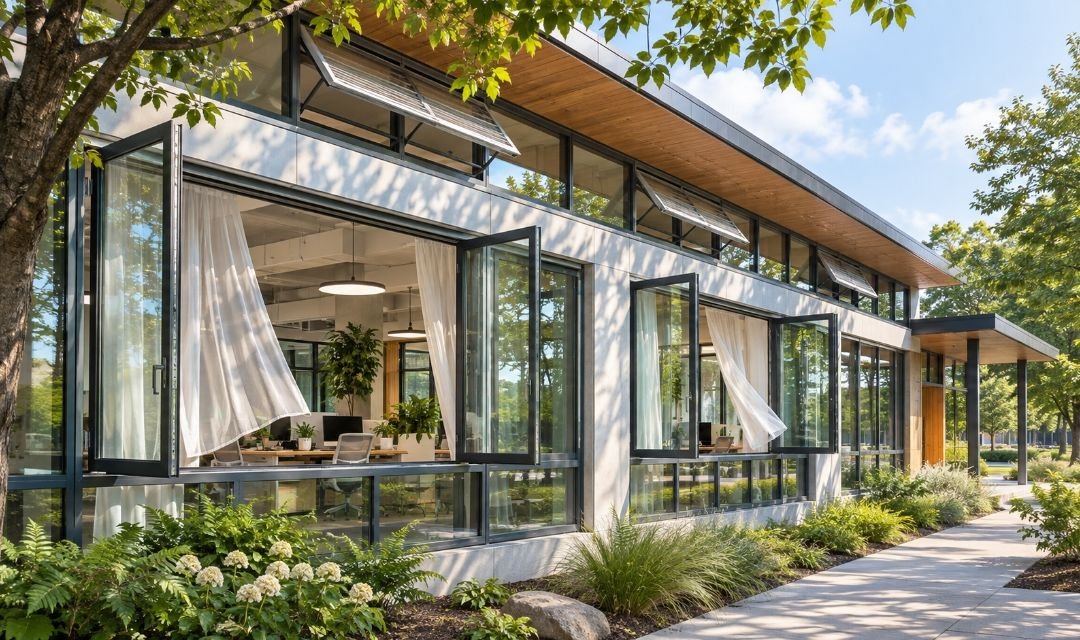
Every commercial building has to deal with heat, stale air, and moisture. The question is how. Some owners reach straight for powered fans and air conditioning, while others let the building breathe on its own. Natural ventilation, which moves air using nothing more than temperature and pressure, can cut running costs and carbon at the same time. It is not the answer for every site, though, so knowing when it fits is worth a closer look.
This guide walks through what natural ventilation is, where it shines, and where a powered system still makes more sense. By the end, you will have a clear way to judge whether it suits your next build or upgrade.
What Natural Ventilation Actually Means
Natural ventilation uses the simple physics of air movement. Warm air rises, so vents placed high in a building let hot, stale air escape, while lower openings draw cooler air in to replace it. Wind pressure adds to the effect, pushing fresh air through the space. No fans, no ducts, and no electricity are needed to keep the cycle going.
The approach suits large, open buildings especially well. Warehouses, factories, and workshops often trap enormous amounts of heat under the roof, and a well-placed set of roof vents or louvres can clear that heat without a single powered part. Specialists in passive systems, such as Airocle, design these layouts around the specific building, using airflow modelling to confirm the vents will move the volume of air the space needs.
When Natural Ventilation Is the Right Choice
Natural ventilation works best in buildings where heat and air volume are the main challenge. Here are the situations where it tends to win.
- Large industrial spaces. Warehouses, factories, and sheds with high roofs give hot air room to rise and escape, which is exactly what passive systems are built for.
- Buildings with high heat loads. Spaces with ovens, machinery, or heavy sun exposure benefit from constant, free heat removal that does not add to the power bill.
- Sites focused on sustainability. Since the system uses no electricity, it cuts both running costs and carbon, which helps with green building goals.
- Projects watching running costs. With no fans to power or replace, ongoing costs stay low for the life of the building.
- Retrofits on simple rooflines. Many existing buildings can take roof vents or louvres without major structural change.
If a building ticks several of these boxes, natural ventilation deserves a serious look before any powered option.
When a Powered System Makes More Sense
Natural ventilation has limits, and honest advice means naming them. Buildings that need tight control over temperature and humidity, such as clean rooms, data centres, or cold storage, cannot rely on passive airflow alone. Precise conditions call for mechanical systems that can hold a set point no matter the weather outside.
Small or enclosed spaces also struggle, because they lack the height and openings that passive airflow depends on. In those cases, a powered system, or a mix of both, usually does a better job. The smart move is to match the method to what the building actually needs, rather than forcing one approach everywhere.
The Cost and Sustainability Case
Running costs are where natural ventilation really pulls ahead. A powered system draws electricity every hour it runs, year after year, while a passive one does its job for free once installed. Over a building’s life, that gap adds up to a serious saving.
Sustainability gains follow close behind. Cutting fan use lowers both energy demand and carbon output, which matters more each year as buildings face tighter efficiency targets. Owners are applying the same thinking across their sites, from lighting to water. This look at how industrial water recycling can reduce freshwater consumption in manufacturing shows the same logic at work, using smart design to cut a resource bill rather than simply paying it.
Weighing the Investment
Choosing a ventilation method is partly an airflow question and partly a money one. Natural systems usually cost less to run but need the right design up front. Powered systems can cost less to install yet more to operate over time. Working out which balance suits your budget is the heart of the decision.
That trade-off between spending now and saving later shapes many building choices. The same tension appears in this piece on equipment finance and when keeping cash matters more than owning outright, which is a useful lens for any big facility purchase. Ventilation deserves the same clear-eyed sums before a decision is locked.
Questions to Ask Before You Decide
A few simple questions will tell you quickly whether natural ventilation is worth pursuing.
- How big and open is the space? Tall, large buildings favour passive airflow; small, divided ones often do not.
- How much heat does it generate? Heavy heat loads are a strong signal to go natural.
- Do you need precise climate control? If yes, a powered or hybrid system is likely the answer.
- What is your energy budget over time? Low running cost is natural ventilation’s biggest draw.
- What are your sustainability targets? Passive systems help hit them without extra spend.
Honest answers here will point you toward the right method far faster than guesswork.
The Bottom Line
Natural ventilation is a smart, low-cost, and sustainable choice for the right building, which usually means large, open, heat-heavy spaces where precise climate control is not essential. For tightly controlled environments, a powered or hybrid system still earns its place. Weigh the size of the space, the heat it holds, the control you need, and the cost over time, and the right answer tends to reveal itself. Get a specialist to model the airflow before you commit, and you will know for certain whether letting the building breathe on its own is the way to go.