
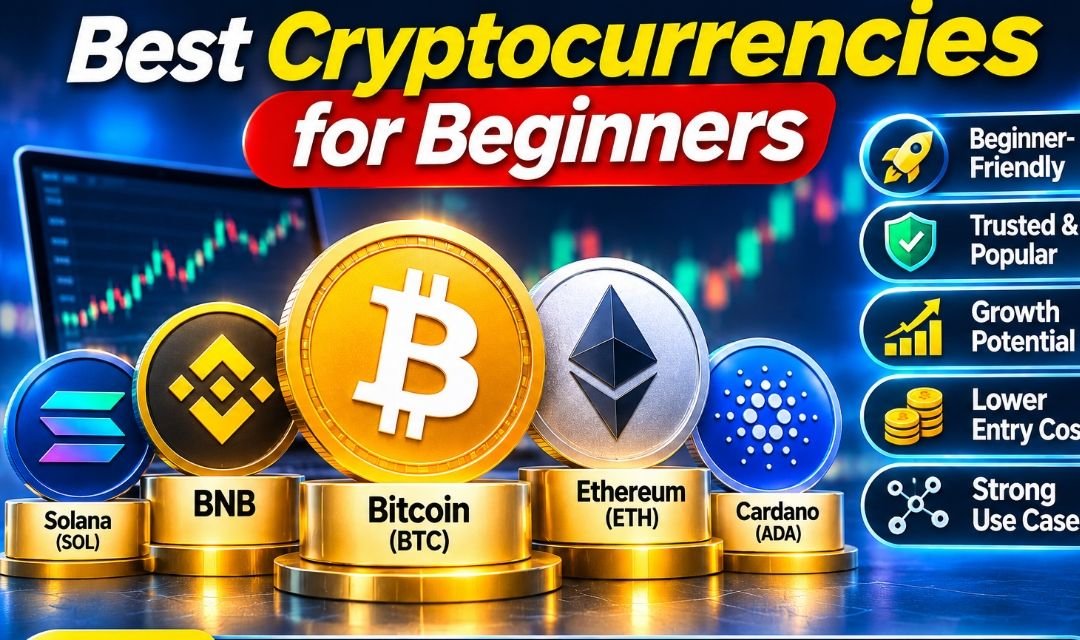
Best cryptocurrencies for beginners is an important topic for people who want to explore Bitcoin, Ethereum, blockchain technology, and digital investments without getting confused by thousands of different coins. Cryptocurrency is a digital asset that uses cryptographic technology to help secure transactions and manage ownership. Some cryptocurrencies focus on digital payments, while others support applications, smart contracts, or financial services. Understanding the basics of cryptocurrency can help beginners compare different projects, recognize financial risks, and make more informed decisions.
Quick Overview: Best Cryptocurrencies for Beginners
| Category | Details |
|---|---|
| Main topic | Best Cryptocurrencies for Beginners |
| Popular starting point for learning | Bitcoin (BTC) |
| Smart contract learning | Ethereum (ETH) |
| Other networks to study | Solana, Cardano, Avalanche |
| Payment-focused examples | Litecoin, XRP |
| Stablecoin examples | USDC, USDT |
| Main technology | Blockchain and distributed ledgers |
| Common uses | Payments, transfers, applications, investment |
| Main risks | Volatility, scams, custody failures |
| Storage options | Software wallets, hardware wallets, custodial accounts |
| Recommended first step | Learn before investing |
| Guaranteed profits | None |
Cryptocurrency has become a major topic in financial technology.
Many beginners are interested in buying digital assets but do not know where to start.
Some hear about Bitcoin through financial news.
Others discover Ethereum, Solana, or meme coins through social media.
However, popularity does not automatically make a cryptocurrency safe.
Different coins have different purposes, technologies, fees, and risks.
Some networks have long operating histories.
Others are newer and more experimental.
This guide compares ten well-known cryptocurrencies that beginners may encounter, explains their uses, and highlights the risks of each.
The list is intended for education, not as a ranking of the safest or most profitable investments.
What Makes a Cryptocurrency Suitable for Beginners to Study?
Before comparing cryptocurrencies, it helps to understand what makes a project easier to research.
A beginner-friendly learning example usually has clear documentation, an understandable purpose, and accessible educational information.
However, ease of learning is not the same as investment safety.
Several factors deserve attention.
Clear Purpose
A cryptocurrency should have an understandable use.
For example, Bitcoin focuses on transferring digital value.
Ethereum supports programmable blockchain applications.
Established Technology
A network with a longer operating history may provide more information for research.
However, age does not eliminate risk.
Accessible Learning Resources
Beginners benefit from clear explanations of wallets, transactions, fees, and security.
Transparent Network Rules
It should be possible to understand how the asset is issued and how the network operates.
Security and Custody
Users should understand how private keys work and what happens if access is lost.
Financial Risks
A cryptocurrency may be easy to purchase but extremely risky to hold.
Market volatility and possible total losses must be considered.
Top 10 Cryptocurrencies for Beginners to Learn About
These are educational examples, not investment recommendations or a ranking by expected returns. Market conditions and regulations can change.
1. Bitcoin (BTC) — Best Starting Point for Understanding Cryptocurrency
Bitcoin
Bitcoin is the first widely adopted cryptocurrency. It launched in 2009 and introduced a decentralized digital value-transfer system.
Bitcoin is often the simplest starting point for learning cryptocurrency fundamentals.
Its main purpose is relatively focused.
It allows people to transfer BTC through a peer-to-peer network.
Bitcoin uses Proof of Work to help secure its blockchain.
It also has a maximum supply of 21 million BTC under its current protocol rules.
However, limited supply does not guarantee rising prices.
Bitcoin can experience major market declines.
Why Beginners Study Bitcoin
-
It provides a foundation for understanding blockchain.
-
Its transaction system is widely documented.
-
It introduces concepts such as wallets, mining, and private keys.
-
It has a long operating history compared with many other cryptocurrencies.
Main risks: Price volatility, custody mistakes, transaction fees, scams, and regulatory uncertainty.
2. Ethereum (ETH) — Best for Learning Smart Contracts
Ethereum
Ethereum is a blockchain platform that supports smart contracts and decentralized applications. Its native cryptocurrency is Ether.
Ethereum launched in 2015.
It allows developers to build programs that run on blockchain networks.
These programs are called smart contracts.
Ethereum supports applications involving digital assets, lending protocols, and other services.
However, smart contracts can contain vulnerabilities.
Ethereum also uses transaction fees known as gas fees.
Why Beginners Study Ethereum
-
It introduces smart contracts.
-
It explains how decentralized applications work.
-
It helps users understand tokens and network fees.
-
It demonstrates Proof-of-Stake consensus.
Main risks: Market volatility, smart contract failures, scams, transaction costs, and application complexity.
3. Solana (SOL) — Best for Exploring Fast Blockchain Networks
Solana
Solana is a blockchain network designed to support applications and high transaction throughput.
Solana supports smart contracts and digital assets.
Its design aims to process transactions efficiently.
Developers use the network for various blockchain applications.
However, faster processing does not automatically mean lower overall risk.
Network reliability, security, and application quality remain important.
Why Beginners Study Solana
-
It demonstrates a different blockchain architecture.
-
It helps explain transaction throughput.
-
It supports programmable applications.
-
It provides a comparison with Ethereum.
Main risks: Price volatility, technical issues, network reliability concerns, and application scams.
4. Cardano (ADA) — Best for Learning Research-Driven Blockchain Development
Cardano
Cardano is a Proof-of-Stake blockchain network that emphasizes research-based development and formal methods.
Cardano supports digital asset transfers and smart contract applications.
Its development approach places importance on technical research.
However, a research-focused approach does not guarantee market success.
Adoption, application quality, and competition remain important.
Why Beginners Study Cardano
-
It provides another example of Proof of Stake.
-
It introduces different blockchain design choices.
-
It demonstrates the role of technical research.
-
It allows comparison with other smart contract networks.
Main risks: Price volatility, adoption uncertainty, technology risks, and competition.
5. Litecoin (LTC) — Best for Understanding Payment-Focused Cryptocurrencies
Litecoin
Litecoin is a cryptocurrency introduced in 2011 that focuses on digital value transfers.
Litecoin shares several design ideas with Bitcoin.
However, it uses different network parameters.
Its target block interval is shorter than Bitcoin’s.
Litecoin can help beginners understand how payment-focused cryptocurrencies may differ.
However, faster blocks do not automatically make an asset a better investment.
Why Beginners Study Litecoin
-
It offers a comparison with Bitcoin.
-
Its main purpose is relatively easy to understand.
-
It introduces differences in mining and network parameters.
-
It helps explain transaction confirmations.
Main risks: Volatility, market competition, custody risks, and uncertain long-term demand.
6. XRP — Best for Learning About Payment and Settlement Networks
XRP
XRP is the native digital asset of the XRP Ledger, a network designed to support digital transfers and settlement.
The XRP Ledger uses a consensus process that differs from Bitcoin mining.
It is often discussed in connection with payment technology.
However, XRP ownership does not automatically provide ownership in any company.
Its investment value remains uncertain.
Why Beginners Study XRP
-
It demonstrates an alternative consensus approach.
-
It introduces payment-focused blockchain design.
-
It provides a comparison with Bitcoin and Ethereum.
-
It helps explain digital settlement systems.
Main risks: Market volatility, regulatory uncertainty, adoption risk, and custody problems.
7. Avalanche (AVAX) — Best for Exploring Blockchain Infrastructure
Avalanche
Avalanche is a blockchain ecosystem that supports smart contracts and customizable blockchain infrastructure.
Avalanche provides another example of how blockchain networks can be designed.
Developers may use its infrastructure to create applications.
However, technical flexibility does not guarantee widespread adoption.
Projects must still attract users and maintain reliable services.
Why Beginners Study Avalanche
-
It introduces alternative blockchain infrastructure.
-
It helps explain network customization.
-
It supports smart contract applications.
-
It provides a comparison with Ethereum.
Main risks: Volatility, technical complexity, competition, and application security.
8. Chainlink (LINK) — Best for Understanding Blockchain Oracles
Chainlink
Chainlink is associated with oracle technology that helps blockchain applications use information from outside their networks.
Smart contracts cannot automatically verify every real-world event.
Oracle systems help supply external data to blockchain applications.
For example, certain financial applications need price information.
However, oracle systems introduce their own technical and trust considerations.
The LINK token is part of the Chainlink ecosystem.
Why Beginners Study Chainlink
-
It explains the role of external data in smart contracts.
-
It introduces oracle technology.
-
It helps users understand blockchain infrastructure.
-
It shows that not every crypto token is designed mainly for payments.
Main risks: Token volatility, technical dependencies, competition, and adoption uncertainty.
9. USD Coin (USDC) — Best for Learning About Fiat-Referenced Stablecoins
USD Coin
USDC is a stablecoin designed to maintain a value linked to the US dollar.
Stablecoins differ from cryptocurrencies such as Bitcoin.
Their goal is generally to maintain a reference value rather than experience large price changes.
However, USDC is not risk-free.
Its value depends on reserve arrangements, redemption mechanisms, issuer operations, and market conditions.
It can also face temporary deviations from its intended peg.
Why Beginners Study USDC
-
It explains how stablecoins operate.
-
It introduces reserve-backed digital assets.
-
It demonstrates the role of tokenized currency transfers.
-
It helps distinguish price stability goals from actual guarantees.
Main risks: Issuer risk, reserve risk, depegging, custody issues, and regulatory changes.
10. Tether (USDT) — Best for Understanding Stablecoin Market Infrastructure
Tether
USDT is a widely recognized stablecoin designed to track the US dollar.
USDT is used in many cryptocurrency trading and transfer systems.
However, its design differs from decentralized cryptocurrencies such as Bitcoin.
Users depend on the issuer’s arrangements and the functioning of relevant markets.
Stablecoin ownership is not automatically equivalent to holding insured bank deposits.
Why Beginners Study USDT
-
It explains the role of stablecoins in crypto markets.
-
It introduces issuer-backed digital assets.
-
It helps explain trading pairs and liquidity.
-
It demonstrates the importance of redemption and reserve risks.
Main risks: Issuer risk, depegging, regulatory restrictions, and network or custody mistakes.
Best Cryptocurrencies for Beginners: Comparison Table
| Cryptocurrency | Main purpose | Main technology | Important beginner risk |
|---|---|---|---|
| Bitcoin (BTC) | Digital value transfer | Proof of Work | Price volatility |
| Ethereum (ETH) | Smart contracts | Proof of Stake | Application complexity |
| Solana (SOL) | Blockchain applications | Proof of Stake-based design | Network and technical risks |
| Cardano (ADA) | Smart contract platform | Proof of Stake | Adoption uncertainty |
| Litecoin (LTC) | Digital payments | Proof of Work | Market competition |
| XRP | Digital settlement | XRP Ledger consensus | Regulatory and market risks |
| Avalanche (AVAX) | Blockchain infrastructure | Proof of Stake-based consensus | Technical and adoption risks |
| Chainlink (LINK) | Oracle services | Oracle network infrastructure | Token and adoption risks |
| USDC | Dollar-referenced stablecoin | Issued across supported networks | Issuer and depegging risks |
| USDT | Dollar-referenced stablecoin | Issued across supported networks | Issuer and depegging risks |
The table compares their main purposes.
It does not indicate which cryptocurrency will perform best financially.
Which Cryptocurrency Is Easiest for Beginners to Understand?
Bitcoin is often one of the easiest starting points for learning basic cryptocurrency concepts.
Its primary function is relatively focused.
Ethereum is useful for learning about smart contracts.
Stablecoins help explain digital representations of currency-linked value.
However, the easiest cryptocurrency to understand is not necessarily the safest investment.
Beginners should distinguish educational simplicity from financial suitability.
Bitcoin vs Ethereum vs Solana for Beginners
Bitcoin, Ethereum, and Solana represent three different approaches to blockchain technology.
| Feature | Bitcoin | Ethereum | Solana |
|---|---|---|---|
| Main focus | Digital value transfer | Programmable applications | High-throughput applications |
| Native asset | BTC | ETH | SOL |
| Consensus | Proof of Work | Proof of Stake | Proof of Stake-based |
| Smart contracts | Limited scripting | Extensive support | Extensive support |
| Supply | Fixed maximum | No fixed maximum | Network-defined issuance |
| Main learning topic | Digital money | Smart contracts | Blockchain performance |
Bitcoin may be a useful starting point for understanding decentralized digital money.
Ethereum introduces programmable applications.
Solana offers a different approach to blockchain performance.
However, all three involve market and technical risks.
How to Choose a Cryptocurrency as a Beginner
Choosing a cryptocurrency requires more than comparing prices.
Beginners should evaluate several important factors.
1. Understand the Project’s Purpose
Ask what problem the cryptocurrency is intended to solve.
A clear use case can make a project easier to evaluate.
However, a useful idea does not guarantee investment returns.
2. Research the Technology
Learn how the network validates transactions.
Understand its security design.
Check whether it relies on mining, staking, or another consensus process.
3. Review Token Supply
Some cryptocurrencies have maximum supply limits.
Others use variable issuance rules.
However, supply alone does not determine value.
4. Understand Market Volatility
Cryptocurrency prices can change rapidly.
Even established digital assets can experience substantial losses.
5. Check Wallet Compatibility
Different cryptocurrencies may require different networks and wallet arrangements.
Using the wrong address or network can cause permanent loss.
6. Review Fees
Trading, withdrawals, and network transfers may involve charges.
Compare total costs.
7. Investigate Security
Look for credible technical information and security practices.
However, no blockchain project is completely risk-free.
8. Check Local Regulations
Cryptocurrency rules differ by country.
Verify legal requirements before using financial services.
How Much Should Beginners Invest in Cryptocurrency?
There is no universal amount suitable for every beginner.
Some people may choose not to invest at all.
That is a reasonable decision.
Cryptocurrency can experience extreme volatility.
Before considering any purchase, review essential expenses, emergency savings, debt, and financial goals.
Avoid using money needed for rent, food, healthcare, or education.
Do not borrow money to speculate on cryptocurrency prices.
Learning about digital assets does not require financial exposure.
Cryptocurrency Investment Risk Calculator
This simple calculator shows how a hypothetical investment could change in value under different market conditions.
Cryptocurrency Risk Scenario
Explore possible gains and losses. This is an illustration, not a prediction.
Starting amount
$500
Hypothetical price change
-40%
Final value
$300
Gain or loss
−$200
Hypothetical example only. Excludes transaction fees, taxes, spreads, and other costs. Any cryptocurrency can experience major losses.
How to Buy Cryptocurrency for the First Time
The exact process depends on local regulations and available services.
However, a typical process involves several steps.
First, learn about the cryptocurrency.
Next, check whether the relevant platform is legally available in your country.
Compare fees and security measures.
Understand whether the platform holds customer assets.
Review the purchase amount and transaction costs.
If you decide to proceed, confirm the details carefully.
However, beginners should not feel pressured to buy cryptocurrency immediately.
Education should come first.
How to Store Cryptocurrency Safely
Cryptocurrency storage requires careful attention.
Wallets manage cryptographic keys.
These keys help authorize transactions.
Hot Wallets
Hot wallets operate on internet-connected devices.
They are convenient for regular activity.
However, connected devices can face security threats.
Cold Wallets
Cold wallets keep private keys offline or isolated.
Hardware wallets are a common example.
However, losing recovery information can still cause permanent loss.
Custodial Storage
Some platforms hold cryptocurrency on behalf of customers.
This may simplify account management.
However, users depend on the provider’s financial stability and security.
Self-Custody
Self-custody gives users direct control over private keys.
However, it also creates personal responsibility for protecting them.
Common Cryptocurrency Mistakes Beginners Should Avoid
Beginners often make mistakes because of excitement or incomplete information.
One mistake is buying a coin simply because its price has increased.
Another is following social media influencers without independent research.
Some people invest money they cannot afford to lose.
Others use leverage or borrowed funds.
Another serious mistake is sharing wallet recovery phrases.
Some users also send cryptocurrency through incompatible networks.
Finally, many beginners believe that a low coin price means a cryptocurrency is cheap.
However, the price of one token does not establish the overall value of a project.
Market capitalization, supply, and other factors matter.
Best Cryptocurrency Security Tips for Beginners
Security should be a priority from the beginning.
Beginner Cryptocurrency Safety Checklist
0 of 10
These precautions may reduce common risks but cannot guarantee protection from fraud, technical failures, or financial losses.
Best Cryptocurrency Categories for Beginners
Rather than focusing only on individual coins, beginners can learn about different cryptocurrency categories.
| Category | Example | Main learning benefit |
|---|---|---|
| Digital money | Bitcoin | Decentralized value transfer |
| Smart contract platform | Ethereum | Programmable applications |
| High-throughput blockchain | Solana | Network performance |
| Research-focused blockchain | Cardano | Alternative network design |
| Payment-focused asset | Litecoin | Transaction processing |
| Settlement network asset | XRP | Digital settlement |
| Blockchain infrastructure | Avalanche | Network customization |
| Oracle token | Chainlink | External data for smart contracts |
| Stablecoin | USDC | Fiat-referenced digital assets |
| Stablecoin | USDT | Crypto market settlement |
Are Stablecoins Better for Beginners?
Stablecoins may appear less volatile than Bitcoin or Ethereum because they aim to maintain a reference value.
However, they introduce different risks.
These include issuer failure, reserve problems, redemption restrictions, and depegging.
A stablecoin is not automatically equivalent to money in an insured bank account.
Beginners should understand how a stablecoin maintains its value.
They should also understand who issues it and what redemption rights exist.
Are Meme Coins Good for Beginners?
Meme coins are often influenced by online communities and social media attention.
Some have experienced dramatic price movements.
However, popularity does not establish long-term value.
Meme coins may involve extreme speculation, concentrated ownership, and liquidity risks.
Beginners should be especially cautious about buying assets based on viral trends.
A coin becoming popular online does not guarantee that it is legitimate or financially suitable.
Cryptocurrency vs Traditional Investments
Cryptocurrency differs from traditional investments in several ways.
| Feature | Cryptocurrency | Stocks | Bank savings |
|---|---|---|---|
| Main nature | Digital assets | Company ownership | Deposit account |
| Price volatility | Often very high | Varies | Generally low for account balance |
| Income | Depends on asset and arrangements | Some pay dividends | May pay interest |
| Consumer protection | Varies widely | Regulated market protections vary | Deposit protection may apply |
| Main risk | Market, custody, technical risks | Business and market risks | Inflation and institution-related risks |
| Guaranteed profits | No | No | Interest terms may be specified, subject to conditions |
Cryptocurrency should not be treated as a direct replacement for emergency savings.
Final Thoughts
The best cryptocurrencies for beginners are not necessarily the coins with the highest prices, biggest communities, or strongest recent market performance.
A useful starting point is understanding what each cryptocurrency does.
Bitcoin introduces decentralized digital money.
Ethereum explains smart contracts and programmable applications.
Solana, Cardano, and Avalanche demonstrate different blockchain designs.
Litecoin and XRP provide examples of payment-focused digital assets.
Chainlink introduces oracle technology.
USDC and USDT help explain stablecoins and currency-linked digital transfers.
However, every cryptocurrency involves risks.
Prices may change dramatically.
Wallet mistakes can result in permanent losses.
Scams and technical failures remain serious concerns.
Beginners should focus on education, careful research, and security rather than promises of quick profits.
Understanding cryptocurrency technology is valuable even if you never purchase a digital asset.
Frequently Asked Questions About the Best Cryptocurrencies for Beginners
1. What are the best cryptocurrencies for beginners?
Bitcoin and Ethereum are common starting points for learning. Other networks, such as Solana and Cardano, can help beginners explore different blockchain technologies.
2. Is Bitcoin good for beginners?
Bitcoin is useful for learning basic cryptocurrency concepts, but investing in it involves substantial risk.
3. Is Ethereum good for beginners?
Ethereum is useful for learning about smart contracts and decentralized applications.
4. Which cryptocurrency is the safest?
No cryptocurrency is completely safe. Different assets involve different market, technical, and custody risks.
5. Can beginners invest small amounts in cryptocurrency?
Some platforms allow small purchases, although minimum amounts and fees vary.
6. Do I need to buy a whole Bitcoin?
No. Bitcoin can be divided into smaller units.
7. What is the difference between Bitcoin and Ethereum?
Bitcoin focuses primarily on digital value transfer, while Ethereum supports programmable blockchain applications.
8. What is Solana?
Solana is a blockchain network designed to support applications and high transaction throughput.
9. What is Cardano?
Cardano is a Proof-of-Stake blockchain platform with a research-focused development approach.
10. What is Litecoin?
Litecoin is a payment-focused cryptocurrency introduced in 2011.
11. What is XRP?
XRP is the native digital asset of the XRP Ledger.
12. What is Avalanche?
Avalanche is a blockchain ecosystem supporting smart contracts and customizable infrastructure.
13. What is Chainlink?
Chainlink is an oracle network associated with providing external information to blockchain applications.
14. What is USDC?
USDC is a stablecoin designed to maintain a value linked to the US dollar.
15. What is USDT?
USDT is a stablecoin designed to track the US dollar.
16. Are stablecoins risk-free?
No. Stablecoins can experience issuer problems, redemption restrictions, and depegging.
17. Can cryptocurrency prices fall suddenly?
Yes. Cryptocurrency markets can experience rapid and substantial declines.
18. What is a cryptocurrency wallet?
A wallet manages the cryptographic keys used to control digital assets.
19. What is a private key?
A private key is secret cryptographic information used to authorize certain cryptocurrency transactions.
20. Can cryptocurrency be stolen?
Yes. Theft can occur through scams, compromised devices, stolen keys, and security failures.
21. Are cryptocurrency investments guaranteed?
No. Cryptocurrency investments do not offer guaranteed profits.
22. Is cryptocurrency legal everywhere?
No. Regulations vary by country.
23. Should beginners trade cryptocurrency daily?
Frequent trading can involve significant risks and costs, particularly for inexperienced users.
24. Can beginners learn cryptocurrency without investing?
Yes. Blockchain and cryptocurrency technology can be studied without purchasing digital assets.
25. What is the best way to start learning cryptocurrency?
Begin with Bitcoin, blockchain technology, wallets, transaction security, and the differences between major cryptocurrency networks.
For more cryptocurrency guides, blockchain education, Bitcoin comparisons, and beginner-friendly financial articles, visit Picanto Magazine