
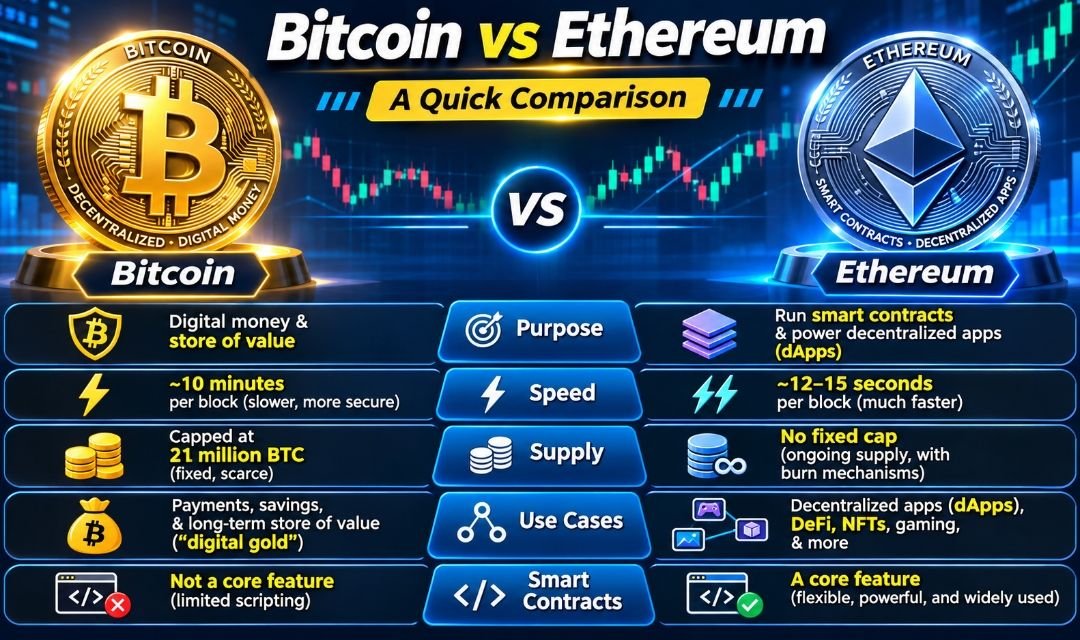
Bitcoin vs Ethereum is one of the most important comparisons for anyone learning about cryptocurrency and blockchain technology. Bitcoin is widely known as a decentralized digital asset designed for transferring value, while Ethereum is a blockchain platform that supports digital payments, smart contracts, and decentralized applications. Both use blockchain technology to record transactions, but they differ in purpose, network design, transaction processing, and supply rules. Understanding these differences can help beginners learn how the two networks operate and evaluate their benefits, limitations, and risks.
Quick Overview: Bitcoin vs Ethereum
| Feature | Bitcoin (BTC) | Ethereum (ETH) |
|---|---|---|
| Launch year | 2009 | 2015 |
| Main creator | Satoshi Nakamoto | Vitalik Buterin and other co-founders |
| Native cryptocurrency | Bitcoin (BTC) | Ether (ETH) |
| Main purpose | Digital value transfer | Smart contracts and decentralized applications |
| Consensus mechanism | Proof of Work | Proof of Stake |
| Maximum supply | 21 million BTC | No fixed maximum supply |
| Typical block interval | About 10 minutes | About 12 seconds per slot |
| Smart contracts | Limited scripting capabilities | Extensive programmable smart contracts |
| Transaction fees | Paid in BTC | Paid in ETH |
| Energy consumption | Higher due to mining | Much lower since moving to Proof of Stake |
| Popular applications | Payments, holding digital value | DeFi, NFTs, tokens, blockchain applications |
| Investment risk | High | High |
Bitcoin and Ethereum are two of the most recognized cryptocurrency networks.
Although both use blockchain technology, they were developed with different goals.
Bitcoin introduced a system for transferring digital value without relying on a central authority to maintain its ledger.
Ethereum expanded the possibilities of blockchain by allowing developers to create programmable applications.
These differences influence how the networks operate, how users interact with them, and what problems they may solve.
However, neither cryptocurrency is guaranteed to increase in value.
Both involve market volatility, technical risks, and changing regulations.
This guide explains 25 important differences between Bitcoin and Ethereum in simple English.
What Is Bitcoin?
Bitcoin is a decentralized cryptocurrency introduced in 2009.
It was created by a person or group using the name Satoshi Nakamoto.
Bitcoin allows users to transfer digital value through a peer-to-peer network.
Its blockchain maintains a public record of transactions.
Bitcoin uses Proof of Work to help secure the network.
Miners compete to produce valid blocks.
Under Bitcoin’s existing protocol rules, the maximum supply is 21 million BTC.
However, Bitcoin’s limited supply does not guarantee that its price will rise.
Its market value depends on supply, demand, and other economic factors.
Main Features of Bitcoin
-
Decentralized transaction network
-
Maximum supply of 21 million BTC
-
Proof-of-Work consensus
-
Public blockchain
-
Peer-to-peer digital transfers
-
Established network history
-
Limited scripting functionality
-
Significant market price volatility
What Is Ethereum?
Ethereum is a blockchain platform launched in 2015.
It was developed by Vitalik Buterin and other contributors.
Ethereum’s native cryptocurrency is Ether, commonly called ETH.
The Ethereum network supports smart contracts.
Smart contracts are programs that execute according to predefined rules.
Developers use Ethereum to build decentralized applications.
These may include financial protocols, token systems, digital collectibles, and other services.
Ethereum uses Proof of Stake to secure its network.
However, Ethereum applications can involve software vulnerabilities, transaction fees, and financial risks.
Main Features of Ethereum
-
Programmable blockchain platform
-
Native cryptocurrency called Ether
-
Proof-of-Stake consensus
-
Smart contract functionality
-
Decentralized applications
-
Token creation capabilities
-
Layer-2 scaling ecosystem
-
Variable ETH supply
-
Network transaction fees
25 Important Differences Between Bitcoin and Ethereum
1. Bitcoin vs Ethereum: Main Purpose
The biggest difference between Bitcoin and Ethereum is their primary purpose.
Bitcoin was designed mainly to enable peer-to-peer digital value transfers.
Ethereum was designed to support programmable blockchain applications.
Bitcoin emphasizes a relatively focused monetary function.
Ethereum supports a broader range of applications through smart contracts.
However, the two networks also share some capabilities.
Both allow users to transfer their native cryptocurrencies.
Both operate through distributed networks.
2. Bitcoin vs Ethereum: Launch Date
Bitcoin launched in January 2009.
Ethereum launched in July 2015.
Bitcoin therefore has a longer operating history.
However, an older launch date does not automatically mean that an asset is a better investment.
Ethereum introduced additional blockchain functionality.
The two networks have developed in different directions.
3. Bitcoin vs Ethereum: Creators
Bitcoin was introduced by Satoshi Nakamoto.
The real identity behind this name remains unknown.
Ethereum was proposed by Vitalik Buterin and developed with several co-founders and contributors.
However, neither network is operated solely by its original creator.
Both depend on broader communities of developers, network participants, and users.
4. Bitcoin vs Ethereum: Blockchain Technology
Both networks use blockchain technology.
A blockchain records transactions in a sequence of cryptographically linked blocks.
However, their designs differ.
Bitcoin uses an accounting model based on unspent transaction outputs, commonly called UTXOs.
Ethereum uses an account-based model.
These approaches affect how transactions and balances are represented.
Both systems aim to maintain valid shared records.
5. Bitcoin vs Ethereum: Consensus Mechanism
Bitcoin uses Proof of Work.
Miners perform computational work to compete in producing blocks.
Ethereum uses Proof of Stake.
Validators participate in securing the network according to staking rules.
However, both approaches involve different security assumptions and tradeoffs.
Proof of Work vs Proof of Stake
| Feature | Bitcoin | Ethereum |
|---|---|---|
| Consensus | Proof of Work | Proof of Stake |
| Main participants | Miners | Validators |
| Primary resource | Computing power | Staked ETH |
| Specialized mining equipment | Commonly required | Not required for consensus |
| Energy demand | Relatively high | Much lower |
| Network rewards | Mining rewards and fees | Validator rewards and fees |
6. Bitcoin vs Ethereum: Transaction Speed
Bitcoin targets an average block interval of approximately 10 minutes.
Ethereum operates with slots of approximately 12 seconds.
However, block timing does not directly equal final transaction settlement.
Bitcoin transactions may require multiple confirmations.
Ethereum uses its own confirmation and finality mechanisms.
Network conditions can affect processing.
Therefore, actual settlement requirements depend on the application and the amount being transferred.
7. Bitcoin vs Ethereum: Transaction Fees
Both networks charge transaction fees.
Bitcoin fees depend partly on transaction size and demand for block space.
Ethereum fees depend on gas usage and network conditions.
However, neither network guarantees permanently low fees.
Fees may increase during periods of high activity.
Users should review transaction costs before transferring assets.
8. Bitcoin vs Ethereum: Cryptocurrency Supply
Bitcoin has a maximum supply of 21 million BTC under its current protocol rules.
Ethereum does not have a fixed maximum ETH supply.
Ethereum’s supply changes through issuance and fee-burning mechanisms.
However, a fixed supply does not automatically make an asset more valuable.
Demand, liquidity, and other market factors remain important.
9. Bitcoin vs Ethereum: Mining
Bitcoin uses mining as part of its consensus system.
Miners use specialized hardware to perform computational work.
Ethereum no longer uses Proof-of-Work mining.
It transitioned to Proof of Stake in September 2022.
This change is commonly known as the Merge.
However, mining and staking have different operational requirements.
Neither guarantees profits.
10. Bitcoin vs Ethereum: Staking
Ethereum supports native staking.
Validators stake ETH to participate in network security.
They may receive rewards according to network rules.
However, staking involves risks.
These include penalties, technical failures, and changes in ETH’s market price.
Bitcoin does not use native Proof-of-Stake validation.
Services advertising Bitcoin yield generally involve additional arrangements and risks.
11. Bitcoin vs Ethereum: Smart Contracts
Ethereum was designed to support extensive smart contract functionality.
Developers can create programs that operate on the blockchain.
Bitcoin has scripting capabilities, but its base-layer programming model is more limited.
However, smart contracts are not automatically secure.
Software bugs can cause financial losses.
Ethereum’s flexibility creates opportunities and additional technical risks.
12. Bitcoin vs Ethereum: Decentralized Applications
Ethereum supports decentralized applications, commonly called dApps.
These may include trading protocols, lending systems, and digital marketplaces.
Bitcoin’s base network has a more focused design.
However, additional systems and protocols can extend Bitcoin-related functionality.
The practical capabilities depend on the specific application and network layer.
13. Bitcoin vs Ethereum: Security
Both networks use cryptographic methods and consensus rules to protect their ledgers.
Bitcoin’s security relies on Proof of Work.
Ethereum’s security relies on Proof of Stake.
However, neither network is completely free from risk.
Users may lose funds through scams, compromised private keys, or incorrect transactions.
Smart contract vulnerabilities can also affect Ethereum applications.
Network security should not be confused with personal account security.
14. Bitcoin vs Ethereum: Energy Consumption
Bitcoin mining requires significant computing resources.
Its environmental impact depends on energy use and electricity sources.
Ethereum’s transition to Proof of Stake greatly reduced the energy required for its consensus mechanism.
However, energy efficiency alone does not determine a cryptocurrency’s usefulness or investment value.
Environmental considerations are one factor among many.
15. Bitcoin vs Ethereum: Investment Characteristics
Bitcoin and Ethereum are both speculative digital assets.
Bitcoin is often discussed as a possible long-term store of value.
Ethereum is frequently discussed in relation to programmable blockchain applications.
However, these narratives do not guarantee financial returns.
Both cryptocurrencies can experience substantial price declines.
Investors should consider market risk, custody, regulation, and personal financial circumstances.
16. Bitcoin vs Ethereum: Market Volatility
Bitcoin and Ethereum prices can change significantly.
Their market movements are influenced by demand, investor sentiment, liquidity, and economic conditions.
However, neither asset has a stable market price.
Ethereum may experience different price movements from Bitcoin.
Past performance cannot reliably predict future returns.
17. Bitcoin vs Ethereum: Wallets
Bitcoin wallets manage keys used to control BTC.
Ethereum wallets manage keys used to control ETH and interact with compatible applications.
Some wallet products support multiple networks.
However, wallet compatibility should never be assumed.
Sending assets to an incompatible address or network can result in loss.
Always verify the asset, network, and destination before transferring funds.
18. Bitcoin vs Ethereum: Privacy
Bitcoin and Ethereum maintain public transaction records.
Transactions are generally associated with addresses rather than automatically displaying real names.
However, blockchain activity is not completely anonymous.
Transaction patterns may sometimes be connected to individuals.
Users should not assume that cryptocurrency provides complete financial privacy.
19. Bitcoin vs Ethereum: Scalability
Scalability refers to a network’s ability to process increasing activity.
Bitcoin and Ethereum have different design priorities.
Both face limitations in base-layer transaction capacity.
Additional systems can help improve processing efficiency.
However, scaling solutions introduce their own technical and security considerations.
20. Bitcoin vs Ethereum: Layer-2 Solutions
Layer-2 systems operate alongside underlying blockchain networks.
Bitcoin’s Lightning Network is an example of an additional payment-layer system.
Ethereum has a growing ecosystem of rollup-based scaling networks.
However, these systems work differently.
They may involve distinct security assumptions, fees, and withdrawal processes.
Users should understand the specific network before moving funds.
21. Bitcoin vs Ethereum: Token Creation
Ethereum supports token standards that allow developers to create digital assets.
These tokens may represent utility functions, governance rights, or other purposes.
Bitcoin’s base layer does not provide the same general-purpose token programming environment.
However, additional protocols can support certain Bitcoin-related digital assets.
Token creation does not automatically establish value or legitimacy.
22. Bitcoin vs Ethereum: NFTs
Ethereum supports non-fungible tokens, commonly called NFTs.
These are unique digital tokens recorded on a blockchain.
Bitcoin-related protocols can also support certain digital collectibles.
However, the technologies and ownership models differ.
Owning a digital token does not automatically grant copyright in associated content.
NFTs may also lose significant market value.
23. Bitcoin vs Ethereum: Developer Ecosystems
Ethereum supports a broad ecosystem of smart contract developers.
Bitcoin development often emphasizes protocol security, reliability, and payment-related infrastructure.
However, both communities work on improvements.
The number of applications or developers does not automatically establish investment quality.
Network development should be evaluated based on practical outcomes.
24. Bitcoin vs Ethereum: Regulations
Bitcoin and Ethereum may be treated differently under financial regulations.
Legal classification depends on the jurisdiction and the activity involved.
Rules for exchanges, investment products, custody, and taxation can vary.
However, regulations change over time.
Users should check current local requirements before using either cryptocurrency.
25. Bitcoin vs Ethereum: Future Potential
Bitcoin’s future may depend on its continued role in digital value transfer and investment markets.
Ethereum’s future may depend on smart contract adoption, scaling improvements, and application development.
However, neither network’s future is guaranteed.
Technical success does not necessarily produce higher cryptocurrency prices.
Both face competition, security challenges, and regulatory uncertainty.
Bitcoin vs Ethereum: Which Is Faster?
Ethereum generally produces blocks more frequently than Bitcoin.
However, comparing block times alone can be misleading.
Bitcoin’s average block interval is approximately 10 minutes.
Ethereum slots occur approximately every 12 seconds.
Transaction finality depends on the network’s rules.
Some payment systems built on top of these networks may provide faster user experiences.
Therefore, speed should be evaluated according to the actual service being used.
Bitcoin vs Ethereum: Which Has Lower Fees?
There is no permanent winner for transaction fees.
Bitcoin fees depend on network demand and transaction characteristics.
Ethereum fees depend on gas usage and activity.
Layer-2 solutions may offer lower fees for certain transactions.
However, transferring assets between networks or layers may create additional costs.
Always check the total fee before sending cryptocurrency.
Bitcoin vs Ethereum: Which Is More Secure?
Both networks have established security mechanisms.
However, they rely on different consensus systems.
Bitcoin uses Proof of Work.
Ethereum uses Proof of Stake.
A simple claim that one is always more secure than the other would ignore important technical differences.
Security also depends on wallet management, software quality, and user behavior.
For example, a secure blockchain cannot prevent someone from voluntarily sending cryptocurrency to a scammer.
Bitcoin vs Ethereum: Which Is Better for Beginners?
The answer depends on what someone wants to learn.
Bitcoin may be easier to understand when starting with basic cryptocurrency transfers and digital scarcity.
Ethereum introduces additional concepts such as gas, smart contracts, and decentralized applications.
However, beginners can study both without purchasing either asset.
Learning the technology is different from making an investment decision.
Both BTC and ETH involve financial risks.
Bitcoin vs Ethereum: Which Is Better for Long-Term Investment?
Neither cryptocurrency can be declared universally better for long-term investing.
Bitcoin has a fixed maximum supply and a relatively focused network purpose.
Ethereum supports programmable applications and has different supply rules.
However, investment returns depend on future market conditions.
Both assets can lose substantial value.
A suitable investment decision requires consideration of financial goals, risk tolerance, and overall financial stability.
Hypothetical Bitcoin vs Ethereum Investment Comparison
The following example shows how two imaginary investments might change under different market conditions.
Bitcoin vs Ethereum Scenario Calculator
Compare hypothetical changes to separate $1,000 investments. These are not market predictions.
Bitcoin price change
-20%
Ethereum price change
+15%
Bitcoin final value
$800
-20% hypothetical change
Ethereum final value
$1,150
+15% hypothetical change
Illustrative only. Excludes fees, taxes, and other expenses. Neither cryptocurrency is guaranteed to achieve any particular return.
Bitcoin vs Ethereum: Advantages and Disadvantages
Advantages of Bitcoin
Bitcoin has a long operating history.
Its maximum supply is defined by protocol rules.
It supports peer-to-peer digital value transfers.
However, Bitcoin’s price remains volatile.
Its base-layer transaction capacity is limited.
Mining also requires significant energy.
Advantages of Ethereum
Ethereum supports programmable applications.
Its smart contract functionality enables a wide range of blockchain services.
Its Proof-of-Stake system requires much less energy than Proof-of-Work mining.
However, Ethereum applications can be complex.
Smart contracts may contain vulnerabilities.
Network fees can also increase during busy periods.
Bitcoin vs Ethereum: Common Mistakes to Avoid
Beginners sometimes assume that Bitcoin and Ethereum are interchangeable.
However, they use different networks.
Sending cryptocurrency through the wrong network can cause losses.
Another mistake is focusing only on market prices.
Technology, custody, fees, and regulations also matter.
Some people assume that Ethereum’s smart contract capabilities make ETH a guaranteed investment.
Others believe Bitcoin’s limited supply guarantees future price increases.
Neither claim is reliable.
Avoid making decisions based on social media hype or promises of guaranteed profits.
How to Learn Bitcoin and Ethereum Safely
A structured learning approach can help beginners understand both networks.
| Learning stage | Bitcoin topic | Ethereum topic |
|---|---|---|
| Week 1 | Bitcoin basics | Ethereum basics |
| Week 2 | Bitcoin transactions | Ethereum transactions |
| Week 3 | Proof of Work | Proof of Stake |
| Week 4 | Bitcoin wallets | Ethereum wallets |
| Week 5 | Mining and supply | Staking and supply |
| Week 6 | Fees and confirmations | Gas and finality |
| Week 7 | Lightning Network | Layer-2 rollups |
| Week 8 | Security and risks | Smart contract security |
You can complete this learning plan without investing money.
Final Thoughts
Bitcoin vs Ethereum is an important comparison for understanding modern cryptocurrency technology.
Bitcoin introduced a decentralized system for transferring digital value.
Ethereum expanded blockchain capabilities through smart contracts and programmable applications.
Bitcoin uses Proof of Work.
Ethereum uses Proof of Stake.
Bitcoin has a maximum supply of 21 million BTC.
Ethereum follows different supply and issuance rules.
Both networks have active development communities and important technological applications.
However, both also involve significant risks.
Market prices can change rapidly.
Wallet mistakes can cause permanent losses.
Scams, software vulnerabilities, and regulatory changes may affect users.
For beginners, the best approach is to understand how each network operates before considering financial exposure.
Bitcoin and Ethereum may continue serving different purposes within digital finance, but their future success and investment performance remain uncertain.
Frequently Asked Questions About Bitcoin vs Ethereum
1. What is the main difference between Bitcoin and Ethereum?
Bitcoin focuses primarily on digital value transfer, while Ethereum supports smart contracts and decentralized applications.
2. Which cryptocurrency launched first?
Bitcoin launched in 2009. Ethereum launched in 2015.
3. Is Bitcoin better than Ethereum?
Neither is universally better. They have different designs, purposes, and risks.
4. Is Ethereum faster than Bitcoin?
Ethereum has a much shorter block or slot interval, but transaction finality and settlement requirements differ.
5. Which has lower transaction fees?
Fees vary depending on network activity and transaction type.
6. Does Bitcoin have a maximum supply?
Yes. Bitcoin’s current protocol limits supply to 21 million BTC.
7. Does Ethereum have a maximum supply?
No. Ethereum does not have a fixed maximum ETH supply.
8. Does Bitcoin use mining?
Yes. Bitcoin uses Proof-of-Work mining.
9. Does Ethereum use mining?
No. Ethereum transitioned to Proof of Stake in September 2022.
10. What is Ethereum staking?
Staking involves participating in Ethereum’s Proof-of-Stake system according to network rules.
11. Can Bitcoin support smart contracts?
Bitcoin has scripting capabilities, but they are more limited than Ethereum’s general-purpose smart contract environment.
12. Why is Ethereum popular with developers?
Ethereum supports programmable applications and token systems.
13. Is Bitcoin more secure than Ethereum?
Both use different security models. A universal security ranking would be misleading.
14. Is Ethereum more energy-efficient than Bitcoin?
Ethereum’s Proof-of-Stake consensus uses substantially less energy than Bitcoin’s Proof-of-Work mining.
15. Can I store Bitcoin and Ethereum in the same wallet?
Some multi-asset wallets support both, but compatibility must be verified.
16. Are Bitcoin and Ethereum transactions anonymous?
Not completely. Both maintain public transaction histories.
17. What are Ethereum gas fees?
Gas fees are transaction execution costs paid in ETH.
18. What is the Lightning Network?
It is an additional payment-layer system designed to support certain Bitcoin transactions.
19. What are Ethereum layer-2 networks?
They are scaling systems designed to improve transaction capacity or efficiency.
20. Can Ethereum create other cryptocurrencies?
Ethereum supports token standards used to create various digital assets.
21. Can Bitcoin and Ethereum lose value?
Yes. Both can experience substantial price declines.
22. Is Bitcoin safer for beginners?
Neither cryptocurrency is risk-free. Beginners should understand technology and custody risks before considering a purchase.
23. Which cryptocurrency has more applications?
Ethereum’s design supports a broader range of programmable applications on its base network.
24. Will Ethereum replace Bitcoin?
There is no reliable basis for predicting that one will replace the other.
25. Which is better for long-term investing?
That depends on individual circumstances, and neither asset offers guaranteed returns.
For more cryptocurrency comparisons, blockchain technology guides, Bitcoin education, and beginner-friendly financial articles, visit Picanto Magazine